PU Leather vs Real Leather: What’s the Difference and Which Should You Buy?
PU leather is a polyurethane coating on a fabric backing, made to look like leather. Here's how it's made, how it compares to real leather on durability, cost and care, why it peels, and seven reliable ways to tell them apart.
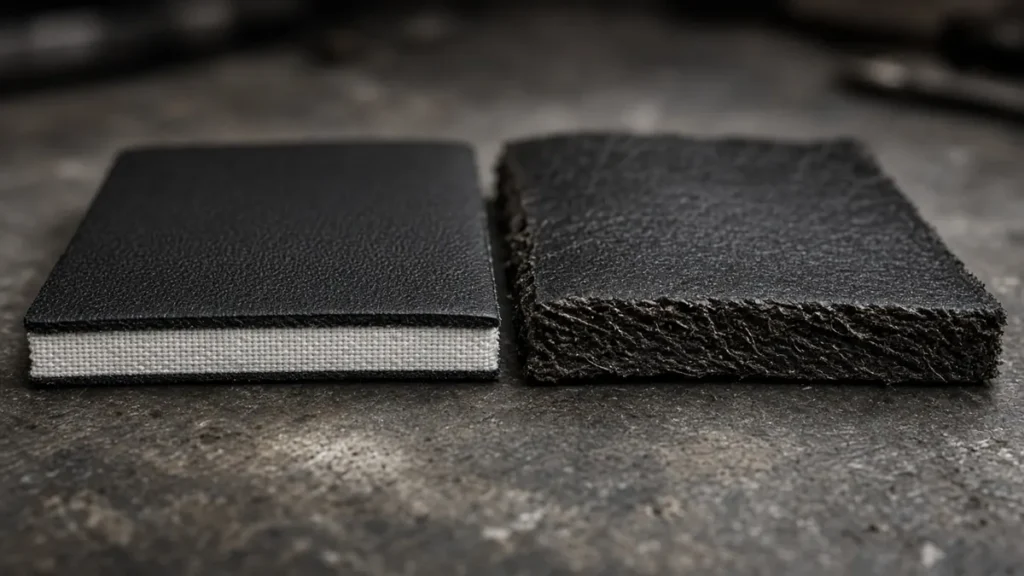
PU leather (polyurethane leather) is an artificial material made by coating a fabric backing, usually polyester or cotton, with a layer of polyurethane that’s embossed to look like leather grain. Fully synthetic PU contains no animal hide. A related material, bicast leather, puts a PU layer on top of a real leather split. Real leather is animal hide preserved by tanning, with a natural fiber structure all the way through.
On the shelf they can look surprisingly alike. In use they behave very differently. We make bags in real full-grain leather, so we see the failure points of both materials up close. This guide explains what PU leather is, where it beats leather and where it doesn’t, why it peels, and how to tell them apart in seconds.
Quick answer: PU leather is plastic on fabric. It’s cheaper, lighter, easy to wipe clean and needs no conditioning, but it doesn’t breathe, can’t be repaired well and tends to crack or peel within a few years of regular use. Real leather costs more, needs light care and, in good grades, lasts decades.
What is PU leather?
PU leather goes by many names: faux leather, synthetic leather, leatherette, vegan leather, pleather, and, in the furniture trade, sometimes “PU” alone. Despite the name, 100% PU “leather” is not leather.
There are two main kinds:
- Fully synthetic PU. A polyurethane layer on a woven, knitted or non-woven fabric. No animal material. This is what most “vegan leather” bags and shoes are.
- Bicast (bycast) leather. A real leather split, the lower, weaker part of the hide, with a polyurethane layer laminated on top and embossed to look like top grain. Canada’s Competition Bureau notes bicast is “also known as PU leather” in furniture (Competition Bureau Canada). It contains leather, but the surface you see and touch is plastic.
How PU leather is made
- A base fabric is prepared (often polyester).
- Liquid polyurethane is applied, in one or more layers, by coating or laminating a pre-cast film.
- The surface is embossed with a grain pattern and colored.
- A top coat sets the sheen (matte, satin or high-gloss “patent”).
Because it’s made on a roll, PU comes in perfectly even widths, colors and textures, which is a real manufacturing advantage.
What is real leather?
Real leather is animal hide, most often cowhide, that has been tanned (with chromium salts, vegetable tannins or other agents) so it won’t rot. Its strength comes from a three-dimensional network of collagen fibers that runs through the whole thickness. The UK testing body SATRA notes that one of the clearest signs a material is not leather is a very consistent, uniform cross-section, while real leather shows a non-uniform fiber structure throughout (SATRA).
Not all real leather is equal. Full grain keeps the original surface; top grain is sanded and refinished; “genuine leather” is often a coated split; bonded leather is shredded scraps glued together. We explain each in full-grain vs top-grain leather.
PU leather vs real leather: side by side
| PU leather | Real full-grain leather | |
|---|---|---|
| What it is | Polyurethane on fabric | Tanned animal hide |
| Look | Uniform, repeating grain | Irregular pores and natural marks |
| Feel | Smooth, cool, slightly rubbery | Warm, varies with tannage |
| Smell | Neutral to plastic or chemical | Leathery |
| Breathability | Low | High |
| Water | Wipe-clean, water-resistant surface | Water-resistant if finished; can mark if soaked |
| How it ages | Cracks, flakes and peels | Softens, darkens, develops a patina |
| Repair | Very limited; peeling can’t be reversed | Scratches buff out; stitching, edges and straps repairable |
| Typical lifespan | A few years of regular use | Decades with basic care |
| Care | Wipe with a damp cloth; no conditioning | Dust, clean gently, condition a few times a year |
| Price | Low | Higher upfront, often lower per year of use |
| Animal products | None (fully synthetic PU) | Yes |
| Disposal | Plastic; doesn’t biodegrade | Biodegrades slowly depending on tannage and finish |
PU vs PVC vs bicast vs bonded: don’t mix them up
Several ranking articles list “split leather” and “corrected grain” as artificial leather. They aren’t: both are real leather, just lower grades. Here’s the correct breakdown.
| Material | Contains leather? | What it is | Typical weak spot |
|---|---|---|---|
| PU (polyurethane) leather | No | PU coating on fabric | Peels and flakes at folds and wear points |
| PVC / vinyl | No | PVC on fabric, often with plasticizers | Stiffens and cracks; can feel sticky in heat |
| Bicast leather | Yes (a split) | Leather split with a PU top layer | PU layer separates from the leather |
| Bonded leather | Partly | Shredded leather fibers glued to a backing, coated | Surface peels in sheets |
| Split / “genuine” leather | Yes | Lower layer of the hide, often coated and embossed | Weaker fibers; finish cracks |
| Corrected / top grain | Yes | Top layer, sanded and refinished | Finish wears at edges |
| Full grain | Yes | Top layer, surface intact | Shows marks (as character) |
In the US, the FTC’s Guides for leather products say that when a material looks like leather but isn’t, that should be disclosed (for example “imitation leather,” “vinyl” or “not leather”), and bonded leather shouldn’t be sold as leather without disclosing its leather-fiber percentage (16 CFR Part 24).
Why PU leather peels and cracks
Two things wear PU out:
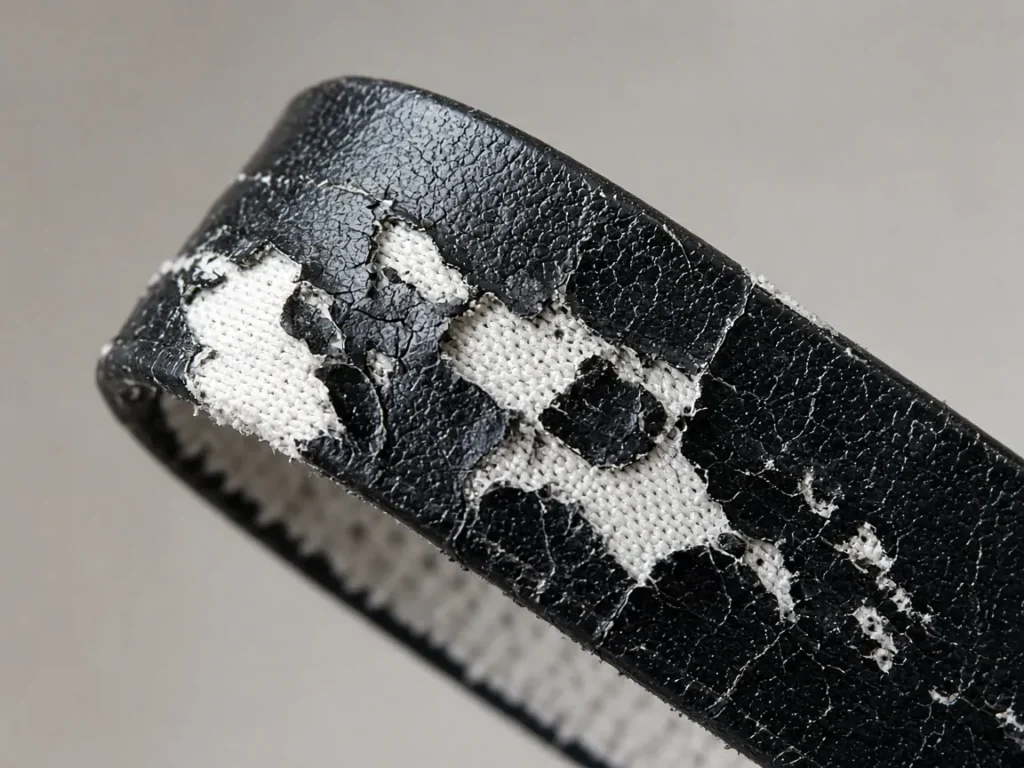
- Flex fatigue. Every fold of a strap, handle root or bag corner bends the polyurethane film. Over thousands of bends, micro-cracks form and spread.
- Chemical breakdown. Polyurethane slowly degrades with heat, humidity, UV and body oils. Over time the film loses flexibility and its bond to the fabric weakens, so it flakes off in patches. This can happen even to items left in a closet.
How fast depends on the grade, thickness and use. One furniture dealer, BTOD, says PU upholstery typically starts cracking and peeling within about two to five years of regular use (BTOD). Bags flex more than sofas at certain points, so straps and handle roots usually fail first.
Real leather fails differently. Its fibers can stretch, scuff or dry out, but they don’t delaminate, and most problems can be fixed by cleaning, conditioning, re-stitching or replacing a strap.
Is PU leather better for the environment?
It depends on what you measure, and anyone giving a one-line answer is selling something.
Points in favor of PU: no animals involved; no tanning, which in poorly run tanneries can pollute water with chromium and other chemicals; efficient roll-based production with little waste.
Points against PU: it’s made from fossil-fuel-based plastics; it doesn’t biodegrade; it’s hard to recycle because the plastic is bonded to fabric; and a shorter lifespan means more replacements.
Points about leather: hides are a by-product of the meat industry; good leather can last for decades and be repaired; but tanning and finishing have their own chemical and water footprints, which vary widely between tanneries.
Our view: the most sustainable bag is the one you keep the longest. For a vegan bag, a well-made textile bag (canvas, recycled nylon) usually outlasts PU.
7 ways to tell PU leather from real leather
- Read the label. “PU,” “faux,” “vegan,” “man-made materials,” “synthetic” or “leatherette” all mean not leather. “Genuine leather” means real leather, usually a lower grade.
- Look at the edge. Real leather shows a fibrous, compressed edge (often burnished or painted). PU shows a thin plastic skin over fabric, sometimes with threads.
- Check the back. Real leather’s underside is suede-like and fuzzy. PU’s underside is woven or knitted fabric.
- Study the grain. Real leather has irregular pores and small marks that vary across the piece. PU repeats the same pattern, sometimes visibly.
- Press and fold. Real leather wrinkles like skin when you press it and the creases look natural. PU tends to dimple evenly or crease with sharp, uniform lines.
- Smell it. Not conclusive (some PU is scented) but plastic or chemical smells point to synthetics.
- Water drop (with a caveat). A drop of water usually darkens and soaks into unfinished leather, while it beads on PU. But many real leathers are finished and will also make water bead, so this test only proves something if the drop soaks in.

Skip the “burn test” you’ll see online. It damages the item and is unreliable on finished leather.
When PU leather is the right choice
PU leather is a reasonable pick when:
- You want a trend piece for a season or two.
- You avoid animal products and want a leather look (consider textile bags too).
- The item needs to be wiped clean constantly (kitchen bar stools, kids’ items).
- Budget is the deciding factor and you accept a shorter life.
Real leather is the better choice when:
- You want a bag, belt or wallet to last many years.
- You carry heavy loads that stress handles and straps.
- You want a material that improves with age and can be repaired.
Buying a bag? Check these points
Whatever the material, inspect where bags fail first:
- Handle roots and strap folds. On PU these crack first. On leather, look for double-layered, stitched (not just glued) attachments.
- Edges. Thick, glossy painted edges can chip. Burnished edges are smoother and longer-lasting.
- Corners and base. These take the most abrasion. Real leather scuffs; PU wears through to fabric.
- Lining and stitching. Tight, even stitches and a sturdy lining matter as much as the outer material.
We show how we handle those points in how our bags are made.
Caring for PU vs real leather
PU leather: wipe with a damp cloth and a drop of mild soap; dry it. Skip conditioners (they can’t soak in) and avoid solvents, alcohol and heat, which speed up breakdown. Keep it out of hot cars and direct sun.
Real leather: dust it, clean gently with a barely damp cloth or a pH-balanced leather cleaner, condition two or three times a year, and dry slowly if wet. Full instructions: how to clean a leather bag and can leather get wet?
Our take as leather bag makers
We don’t use PU or bonded leather. Our leather bags are cut from full-grain leather, including heavier buffalo leather, with edges burnished rather than painted and solid brass hardware. If you want a tougher, lighter everyday material, our waxed canvas bags use cotton canvas with full-grain leather at the wear points (so they aren’t vegan).
Want to understand other finishes that sometimes get confused with plastic? Read what is patent leather? and what is pebbled leather?, or browse the whole Leather Guide.
Frequently asked questions
Is PU leather real leather?
No. Fully synthetic PU leather is polyurethane on a fabric backing and contains no animal hide. Bicast leather is the exception: it has a real leather split underneath a PU surface layer, but the surface you see is plastic.
Is PU leather good quality?
It varies. Good PU looks convincing and holds up for a few years of normal use; cheap PU can crack within months. Even high-grade PU doesn’t match quality real leather for lifespan or repairability.
How long does PU leather last?
Usually a few years of regular use, depending on grade and how often it flexes. One furniture retailer estimates two to five years before cracking and peeling on upholstery. Heat, humidity and sunlight shorten that.
Does PU leather peel?
Yes, over time. Repeated bending and slow chemical breakdown of the polyurethane weaken its bond to the fabric backing, so it cracks and flakes, especially at folds, handles and corners.
Is PU leather waterproof?
The PU surface is highly water-resistant and wipes clean, but water can still get through seams and stitch holes. Prolonged heat and humidity are actually worse for PU than occasional rain.
Is PU leather vegan?
Fully synthetic PU leather is vegan. Bicast leather is not, because it has a real leather base. Check the label or the underside: fabric means synthetic; a suede-like back means leather.
What is the difference between PU leather and faux leather?
“Faux leather” is an umbrella term for any leather imitation, including PU and PVC (vinyl). PU leather is one specific type, generally softer and more breathable than PVC.
Is PU leather better than genuine leather?
PU is cheaper, lighter and easier to clean. “Genuine leather” is real leather, usually a lower-grade split, and generally outlasts PU. For the longest life, choose full-grain leather over both.
Can you repair peeling PU leather?
Not really. Filler and color kits can disguise small areas, but once the PU layer separates from its backing, the peeling usually spreads. Real leather is far easier to repair.