What Is Patent Leather? How It’s Made, Pros, Cons and Care
Patent leather is real leather with a hard, mirror-like coating on top. Here is how it's made, how to tell it from PU "patent", what it is good and bad at, and how to clean, fix and store it.

Patent leather is real leather that has been coated with a thin layer of lacquer, varnish or, today, a synthetic resin such as polyurethane, then cured to a hard, mirror-like gloss. Underneath the shine is ordinary animal hide; the coating is what makes it glossy, wipe-clean and highly water-resistant, and also what makes it crease, crack and pick up color transfer in ways normal leather does not.
We build bags in full-grain leather, so we handle a lot of different hides and finishes, and customers ask us about patent leather all the time. This guide explains what it actually is (including the official industry definitions most articles skip), how it’s made, how to tell real patent leather from PU or vinyl “patent”, and how to clean, fix and store it so it lasts.
Quick answer: Patent leather = real leather + a thin, glossy, sealed coating. It is easy to wipe clean and shrugs off light rain, but it does not breathe, does not develop a patina, and the coating can crack at folds and absorb dye from things pressed against it.
What is patent leather, exactly?
The word “patent” has nothing to do with a modern patent. It comes from the early 19th century, when glossy “japanned” or lacquered leather was a novelty. Commercial production in the United States is generally credited to the inventor Seth Boyden of Newark, New Jersey, who began making it around 1818–1819 using a linseed-oil-based lacquer applied in layers (Wikipedia).
Modern patent leather follows the same idea with different chemistry. A finished leather is coated with a pigmented or clear layer, most often polyurethane or acrylic resin, and cured until the surface is hard and glassy.
The official definitions
Most articles stop at “shiny leather.” The trade has stricter wording:
- The leather industry vocabulary used by the Leather Working Group defines patent leather as leather with “a mirror-like effect, obtained by application of a layer of pigmented or non-pigmented varnishes, or synthetic resins, whose thickness does not exceed one third of the total thickness of the product” (LWG glossary).
- EU customs guidance adds a hard number: for a material to be classed as patent leather the coating or plastic sheet must be no thicker than 0.15 mm. A thicker plastic layer that is still under half the total thickness is classed as “patent laminated leather” (EU Access2Markets).
In plain English: in real patent leather, the leather is the main material and the gloss is a thin skin on top. When the plastic layer becomes the main material, it is no longer patent leather.
Is patent leather real leather?
Yes. Genuine patent leather is real animal leather with a coating on top. The confusion comes from three lookalikes that are sold as “patent” in shops and online:
| Material | What it is | Is it leather? |
|---|---|---|
| Patent leather | Real leather (usually cowhide or calf) with a thin glossy coating | Yes |
| Patent split / coated split | A lower split of the hide with a thicker glossy coating | Yes, but a lower grade |
| PU “patent” | Polyurethane film on a fabric backing, given a high gloss | No |
| Vinyl / PVC “patent” | PVC on a fabric backing | No |
In the US, the FTC’s Guides for leather products say that if a material looks like leather but isn’t, that fact should be disclosed (for example “not leather,” “imitation leather” or “vinyl”) (16 CFR Part 24). So a product honestly described just as “patent” or “faux patent” with no mention of leather is usually synthetic. If you want real leather, look for the words “patent leather” or “patent calf/cowhide” on the label.
For a wider look at how real leather and plastic lookalikes compare, see our guide to PU leather vs real leather.
How is patent leather made?
Methods vary by tannery, but the process looks like this:
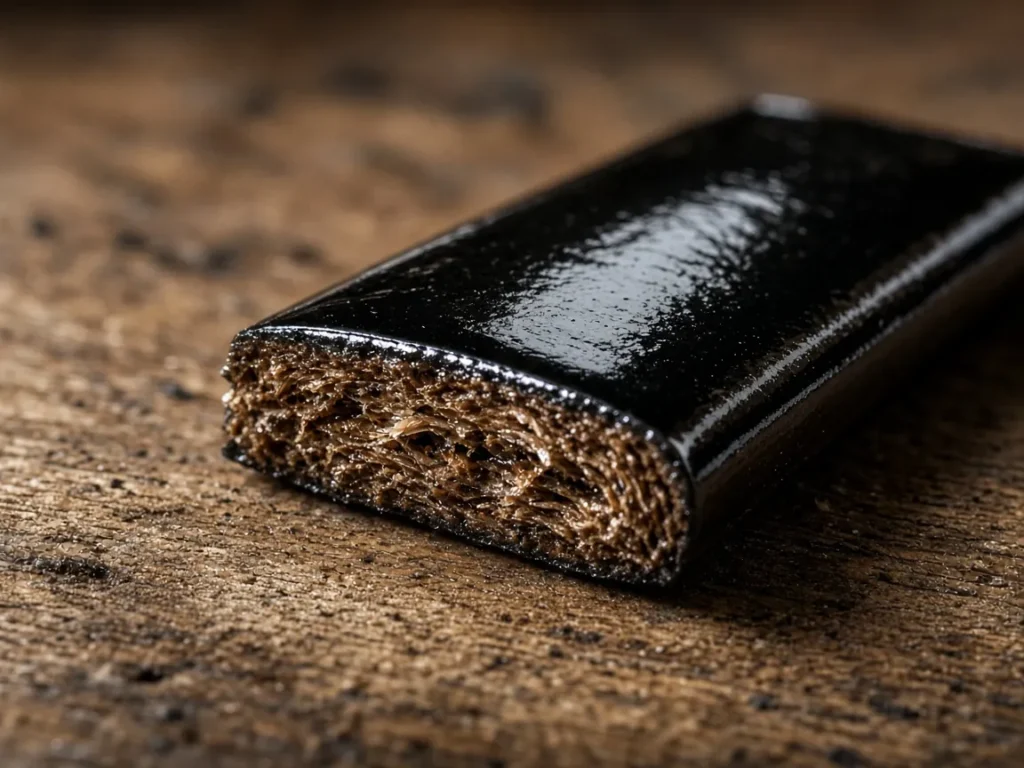
- Start with a finished leather. Usually a smooth, fine-grained cowhide or calfskin. Because the coating hides the surface, the base hide is often corrected (lightly sanded) so it’s perfectly flat.
- Prepare and seal the surface. A base coat fills the pores and gives the gloss layer something even to bond to.
- Color it. Pigment can be in the base coat, the top coat, or both. Clear coats over a dyed hide give a deeper look.
- Apply the gloss layer. Polyurethane or acrylic resin is sprayed, rolled or laminated on. Historically, several coats of linseed-oil varnish were brushed on and sun-cured.
- Cure and finish. Heat or UV cures the coating hard. Some patent leathers are then embossed (for example with a croc pattern) or crinkled, and still count as patent as long as the mirror shine remains.
The result is a material that is part leather, part plastic film, and behaves like both.
Patent leather vs other leathers
| Patent leather | Full-grain leather | Top-grain / corrected | PU “patent” | |
|---|---|---|---|---|
| Surface | Mirror gloss, sealed | Natural pores and marks | Even, lightly finished | Mirror gloss, plastic |
| Breathability | Very low | High | Medium | Very low |
| Water | Highly water-resistant | Water-resistant if finished; marks if soaked | Fairly water-resistant | Water-resistant |
| Ages by | Creasing, possible cracks | Patina, darkening, softening | Slow wear | Peeling, cracking |
| Scratches | Show as dull lines; light ones buff out | Often buff out with a thumb | Show on the finish | Show; can’t be repaired |
| Repairable? | Limited | Very | Moderately | Rarely |
| Best for | Evening bags, formal shoes, statement pieces | Everyday bags that last decades | Uniform colors, budget | Low-cost fashion |
If the trade-off you’re weighing is gloss versus long life, our guide to full-grain vs top-grain leather explains why the unsanded surface ages better.
Pros of patent leather
- That shine. Nothing else gives the same deep, glassy color. It is why patent dominates formal shoes and evening bags.
- Easy to wipe clean. Spills and dust sit on the coating, not in the leather. A damp cloth handles most messes.
- Highly water-resistant. Light rain beads off. (It still isn’t something we’d call waterproof: water can get in through stitch holes, seams and cracks in the coating. More in can leather get wet?)
- Holds its shape. The coating stiffens the leather slightly, so structured bags stay crisp.
- Even, saturated color. Bright reds, nudes and pure black look the same from panel to panel.
Cons of patent leather
- It doesn’t breathe. Fine for a bag; less comfortable in shoes on a hot day.
- No patina. It never gains the warm, darkened character full-grain leather does. It looks best new and degrades from there.
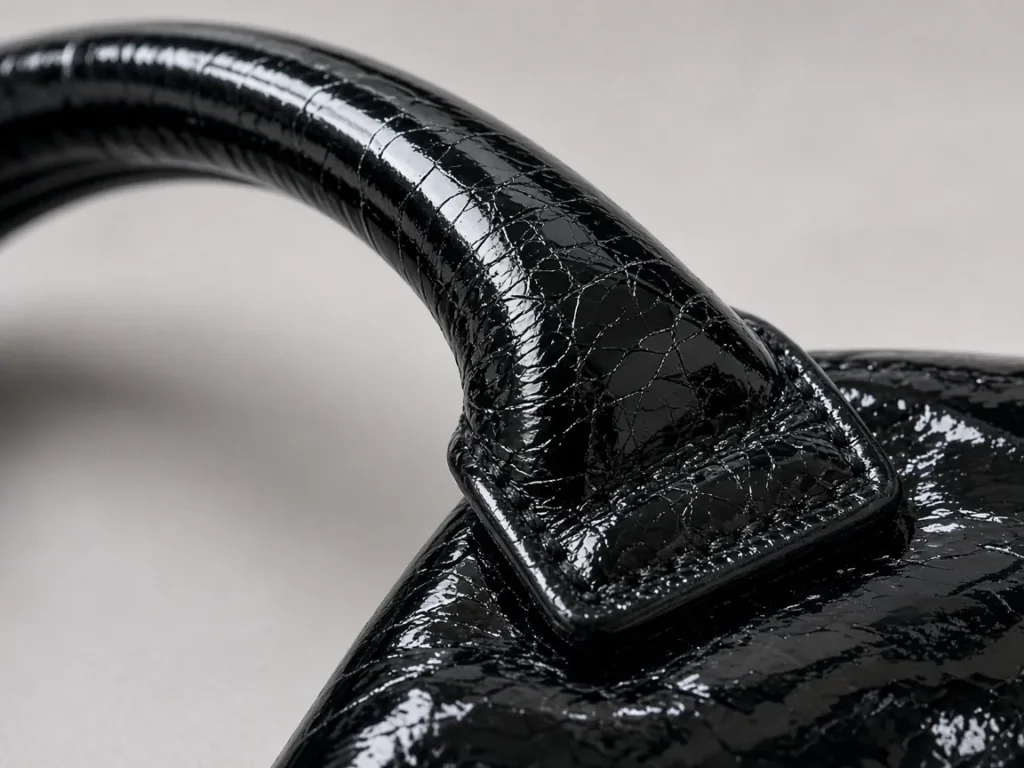
- Creases and cracks. Every time a patent panel folds in the same place (a handle root, a clutch flap, a shoe’s toe crease), the coating flexes. Over time it can craze and crack, and cracked coating can’t be made glossy again.
- Color transfer (dye migration). Patent coatings can absorb dye from denim, newspaper, printed receipts, or another colored patent item pressed against them. On light colors this is often permanent.
- Temperature sensitivity. Very cold weather makes the coating more brittle; heat (a hot car, a radiator) can make it tacky.
- Scuffs are visible. A scrape that would disappear into a textured hide shows as a dull line on a mirror surface.
Where you’ll see patent leather
Because it trades long life for impact, patent leather shows up where looks matter most and wear is lighter:
- Formal and dance shoes. Tuxedo shoes, ballet flats and tap shoes, where a mirror shine is part of the dress code.
- Evening bags and clutches. Small bags that are carried occasionally and stored most of the time.
- Belts and small accessories. Thin belts, wallets and card cases in bold colors.
- Statement outerwear and boots. Trench coats and tall boots, often in black or red.
- Uniform items. Some dress uniforms call for high-gloss shoes that never need polishing, which is exactly what a coated surface delivers.
- Sneakers. Patent overlays have become common on limited-edition sneakers.
What these have in common: the item either isn’t folded much or isn’t expected to last decades. For a work bag you’ll carry five days a week, the folds at the handles and the corners take a beating that a coated surface handles less gracefully than bare leather.
Is patent leather good value?
Patent leather sits in an odd spot. Real patent leather costs more to make than PU, but the coating means it often starts from a corrected (sanded) hide rather than the finest full-grain, because the surface won’t be seen. You are paying for the finish, not for the grade of hide underneath.
That makes it good value for an occasion piece you’ll look after, and poorer value for an everyday bag. If you want a bag measured in decades rather than seasons, put the money into the hide itself.
How to tell real patent leather from PU or vinyl
You can usually tell in under a minute:
- Read the label. Real leather will say leather (patent leather, patent calf, patent cowhide). “Patent PU,” “faux patent,” “vegan patent” and “man-made materials” mean synthetic.
- Look at the cut edge or an unlined inside. Real patent leather shows a fibrous, suede-like leather layer under the gloss. Synthetic shows woven or knitted fabric under a plastic film.
- Check the inside of a handle or strap. If the back of the strap is suede-like leather, the material is likely leather.
- Press and release. Leather under the coating has some “body” and warms in your hand; vinyl feels thinner, cooler and more rubbery.
- Smell it. Not conclusive, but strong plastic odor suggests vinyl or PU.
- Price check. Real patent leather costs considerably more to produce than PU. A very cheap “patent leather” bag deserves a second look at the label.
How to clean patent leather
Patent leather is one of the easiest leathers to clean, as long as you treat it like a coated surface, not like bare leather.
- Dust first. Wipe with a dry, soft microfiber cloth to lift grit so you don’t grind it into the gloss.
- Wipe with a barely damp cloth. Use lukewarm water. For greasy marks, add a drop of mild, dye-free soap to the water.
- Dry immediately. Buff with a dry microfiber cloth to prevent water spots.
- Buff light scuffs. Many cobblers use a pea-sized amount of petroleum jelly on a soft cloth, buffed in small circles and wiped off completely. A product made specifically for patent leather works too. Test first on a hidden spot.
- Restore shine. A final buff with a clean dry cloth is usually all it needs.
Avoid: acetone and nail-polish remover, rubbing alcohol, abrasive pads or magic erasers, and silicone sprays on the gloss. These can dissolve, dull or haze the coating. Regular leather conditioners aren’t needed on the glossy face, because the coating doesn’t absorb them.
For bags in other leathers, follow our full step-by-step guide on how to clean a leather bag.
Troubleshooting: common patent leather problems
| Problem | Likely cause | What to try | Fixable? |
|---|---|---|---|
| Dull, cloudy patch | Residue, hard water, a solvent | Damp cloth, then dry buff; patent-specific cleaner | Usually |
| Light scuff marks | Rubbing against hard surfaces | Petroleum jelly or patent cleaner, buff off | Usually |
| Deep scratch | Coating cut through | Professional touch-up; may remain visible | Partly |
| Color transfer (blue from jeans, ink from print) | Dye migrated into the coating | Act fast with a patent cleaner; a pro may lighten it | Often permanent |
| Sticky or tacky surface | Heat or age breaking down the coating | Keep cool and dry; a pro can sometimes refinish | Rarely |
| Fine cracks at folds | Repeated flexing, cold, dryness | Prevent spreading by storing flat and stuffed | No (cosmetic) |
| Yellowing on white patent | UV exposure, age | Store away from light | No |
How to store patent leather bags
Most patent damage happens in the closet, not on the street:
- Store each piece separately in a breathable cotton dust bag. Patent pressed against patent, printed paper or dark fabric is how color transfer happens.
- Stuff bags with acid-free tissue so the panels don’t fold in the same place.
- Keep it cool and dry, away from radiators, windowsills and hot cars.
- Never store it in plastic. It traps moisture and can make the coating tacky.
- Store upright on a shelf rather than hanging by the strap.
Our general guide on how to care for leather bags covers storage in more detail.
Should you buy a patent leather bag?
Patent leather is a good choice if you want a crisp, high-gloss piece for evenings, weddings or formal outfits, and you’re happy to treat it as an occasion bag. It is a weaker choice for a bag you’ll carry every day for years: the coating wears at the corners and folds, and it never develops the character that makes old leather beautiful.
We don’t make patent leather bags, for exactly that reason. Our bags are built to be used hard and to look better with age, so we cut them in full-grain leather, the top layer of the hide with nothing sanded off. If you want a dressy look that still ages well, a smooth, dark full-grain bag, such as one from our black leather handbags, will take a polish and keep it for years.
For more on the material itself, start with our Leather Guide or the overview of types of leather.
Frequently asked questions
Is patent leather real leather?
Yes. Patent leather is real animal leather, usually cowhide or calfskin, with a thin glossy coating. Products labeled “faux patent,” “patent PU” or “vegan patent” are synthetic and contain no leather.
Is patent leather waterproof?
It is highly water-resistant, not fully waterproof. The coating sheds rain and spills, but water can still enter through stitch holes, seams, edges and any cracks in the coating. Wipe it dry after rain.
Does patent leather crack?
It can. The coating is less flexible than the leather beneath it, so repeated folding in the same place, cold weather and age can cause fine cracks. Storing bags stuffed and flat, and away from heat and cold, slows this down.
How long does patent leather last?
With careful use and storage, a patent leather bag or pair of shoes can look good for many years. Heavy daily use wears the coating at corners and fold lines faster than it would wear an uncoated full-grain leather.
Can you condition patent leather?
The glossy face doesn’t absorb conditioner, so regular leather conditioner is not needed there. Use a product made for patent leather to clean and add shine. Any uncoated leather parts, such as the back of a strap, can be conditioned normally.
How do you get scuff marks off patent leather?
Wipe the area clean, then buff a pea-sized amount of petroleum jelly or a patent-specific cleaner into the mark with a soft cloth and wipe off all residue. Test on a hidden spot first. Deep scratches that cut the coating need a professional.
Can patent leather be repaired?
Light scuffs and haze can usually be buffed out. Deep scratches can sometimes be touched up by a leather repair specialist. Cracked or sticky coating generally can’t be restored to its original gloss.
What is the difference between patent leather and vinyl?
Patent leather has real leather underneath its glossy coating. Vinyl (PVC) “patent” is a plastic film on a fabric backing with no leather in it. Check the label and look at a cut edge: leather shows fibers, vinyl shows fabric.
Why does patent leather change color?
The coating can absorb dye from denim, printed paper or another colored item pressed against it, and light colors can yellow with UV exposure. Store patent pieces separately in cotton dust bags, away from light.