Best Leather Handbags for Women: How to Judge Real Quality
A best-quality leather handbag is defined by its leather, its stitching, its edges, its lining and its hardware, not by its logo. This guide shows you how to judge each one, what you get at each price, which handbag style suits your day, and gives honest picks with real specs and prices.
The best-quality leather handbags are defined by five things you can check yourself: the grade of the leather, the stitching, the edges, the lining and the hardware. A logo tells you who made it and what it cost; it doesn’t tell you whether the handles are glued or the leather has been sanded and painted. A well-made handbag in full-grain leather, with stitched and reinforced stress points and solid hardware, will outlast its trend and look better at year five than on day one.
This guide to the best quality leather handbags shows you exactly what to look for, in a shop or on a product page; what you can expect at each price; which style suits the way you live; and how our own handbags measure up.
Disclosure: We make leather handbags, and we name ours where they fit, with real dimensions and prices (as listed in October 2026). We haven’t tested other brands’ bags, so we don’t rank them. The quality checks below apply to any handbag, including ours. For specific shapes, see our guides to crossbody bags, sling bags, totes and travel handbags.
The best quality leather handbags: a five-point checklist
| What to check | Good sign | Red flag |
|---|---|---|
| Leather grade | “Full grain”, natural grain and small marks visible | “Genuine leather”, “PU”, “vegan leather”, or no grade at all |
| Surface | Grain visible through the colour (aniline or semi-aniline) | Thick, uniform, plastic-looking coating |
| Stitching | Small, even, tight; extra rows at handles | Long, uneven or loose stitches; stitching only at glued tabs |
| Edges | Burnished smooth, or neatly folded | Thick, rubbery paint that is already cracking |
| Handles and strap anchors | Stitched and riveted, reinforced | Glued, single line of stitching |
| Lining | Stitched in; sturdy cotton, twill or leather | Thin, glued, crackly synthetic |
| Hardware | Solid brass or steel, heavy, smooth | Light, plated, grey at the edges |
| Zips | Metal, smooth, covered ends | Light coil zip that catches |
| Base | Separate panel; stands up | Sags on a fold |
| Listing detail | Dimensions, drop, weight, materials, care | Vague or missing specs |
If a handbag passes all ten, it’s well made, whatever it costs.
1. The leather
Leather grades, from best to worst
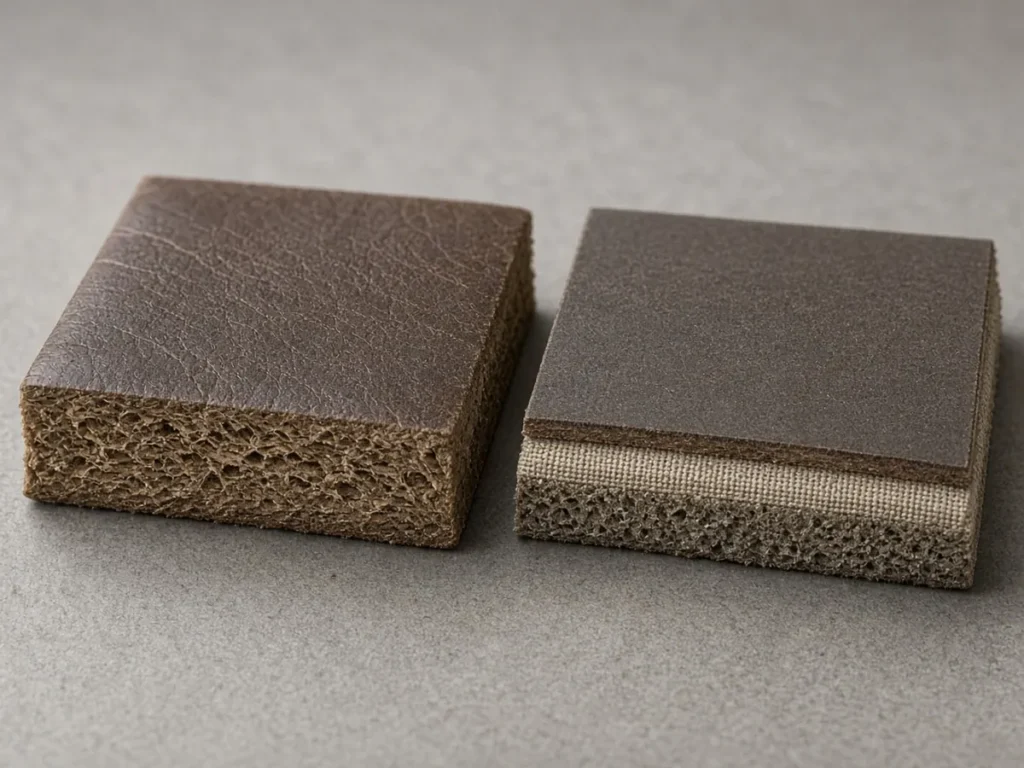
- Full grain. The top layer of the hide with the natural surface left intact. It’s the strongest, most breathable layer, and it ages into a patina instead of cracking. Small scars and grain variation are signs of authenticity, not faults.
- Top grain / corrected grain. The surface has been sanded to remove marks, then sprayed and often embossed. More uniform and marks less at first, but the finish can crack and it doesn’t age as well. Our guide to full grain vs top grain goes deeper.
- Split leather and suede. The lower layers of the hide. Suede is a split with a brushed nap; it’s soft and lovely but less durable than grain leather.
- “Genuine leather”. Despite the name, on a label this usually signals a lower-grade split leather with a coated surface. It is real leather, but rarely the good part.
- Bonded leather. Leather scraps ground and glued into a sheet with a plastic coating. Peels and flakes.
- PU and “vegan leather”. Plastic. See PU vs real leather.
The finish
How the leather is coloured and finished matters almost as much as the grade.
| Finish | What it means | How it ages |
|---|---|---|
| Aniline | Dyed through, no pigment coat | Richest patina; marks more easily |
| Semi-aniline | Dyed, with a thin protective coat | Good balance of character and protection |
| Pull-up | Oils and waxes that lighten when flexed | Scratches buff out; very forgiving |
| Pigmented / coated | Opaque paint layer on top | Uniform; can crack and peel |
| Embossed (e.g. saffiano, some pebbled) | Pattern pressed in, usually coated | Holds its look; doesn’t develop much patina |
| Patent | High-gloss coating | Can crack and yellow |
A quick test online: zoom into the product photos. On full-grain aniline leather you’ll see pores, grain and slight colour variation through the dye. On a heavily coated leather, the surface looks flat and uniform, like paint.
Softness
Soft leathers such as nappa and lambskin feel luxurious but scratch and stretch more. Firmer full-grain cowhide and buffalo hold their shape and stand up to daily use. “Softer” isn’t the same as “better”; it depends on the bag’s job.
2. Stitching
- Stitch length. Small, even stitches look better and hold better. On handbags, stitches are usually packed fairly close; long stitches on a load-bearing seam are a sign of speed over strength.
- Hand saddle stitching. Two needles pass through each hole from opposite sides. If one thread breaks, the stitch doesn’t unravel. Machine lockstitch is fine for many seams, but on handles and strap anchors saddle stitching is the gold standard.
- Straightness. Seams should run parallel to the edge, with no wobbles or doubled-back stitches.
- Thread. Thick, waxed or bonded thread, colour-matched or deliberately contrasting.
- Reinforcement. Handle roots and strap anchors should have extra stitching, a box-and-cross pattern, or rivets.
3. Edges
Edges are where cheap bags show themselves first.
- Burnished edges are sanded, dyed and polished with friction until smooth and sealed. Durable and repairable.
- Folded or turned edges wrap the leather over itself. Clean and very durable; more labour.
- Painted edges use a thick edge paint. Done well, they’re neat; done cheaply, they crack and peel off in strips within a couple of years.
Run a finger along the edge: it should be smooth, even and slightly rounded, with no gaps or bubbles.
4. Lining and inside
- A stitched-in lining can be replaced if it’s ever torn or stained; a glued lining usually can’t.
- Cotton twill, canvas, suede or leather linings outlast thin synthetics.
- At least one zip pocket for keys and cards, and an open pocket for a phone. A key clip is a nice extra.
- Unlined bags (raw suede side inside) are lighter and softer. That’s a design choice, not a fault, as long as the seams are finished.
5. Hardware
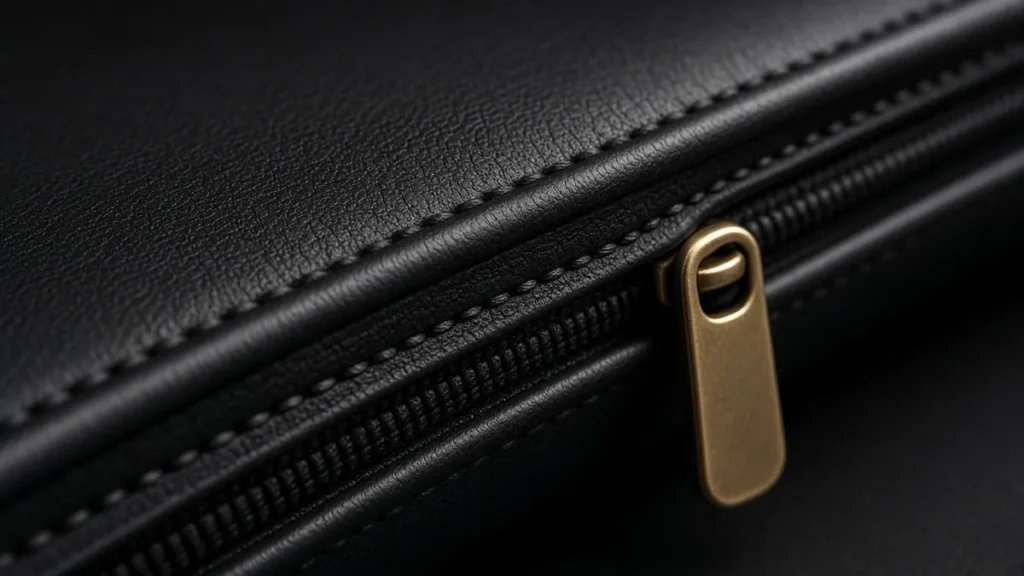
Solid brass and stainless steel don’t flake or chip. Plated zinc alloy is common and cheaper; plating wears through to grey exactly where hands and buckles rub. Feel the weight of a buckle or clasp: quality hardware feels heavy and moves smoothly. Zips should be metal, with leather pulls and finished ends.
Quality myths to ignore
“Heavy means quality.” Weight can come from thick leather, or from heavy, cheap hardware and stiff synthetic linings. Judge the materials, not the scales.
“The stronger the leather smell, the better.” A faint leather smell is normal. A very strong smell can come from heavy finishes or fragrances added to mask synthetic materials.
“‘Genuine leather’ is the best grade.” It’s usually one of the lowest grades of real leather. “Full grain” is the term to look for.
“No marks means better leather.” A perfectly uniform surface often means the leather has been sanded and coated. Small natural marks on full grain are signs of an intact surface.
“Real leather never cracks.” Full grain rarely cracks; heavily coated leathers can crack at folds, especially if they dry out.
“A famous name guarantees quality.” Many luxury houses make exceptional bags, but price includes brand and retail costs, and quality varies across ranges. Apply the same checklist.
“Water ruins leather.” Light rain is fine if you wipe it off and let it dry naturally. Soaking and fast heat-drying are what cause damage (see can leather get wet?).
How quality shows after a year
The real test of a handbag is how it looks after daily use. Here’s what typically happens:
| After a year | Well-made full-grain bag | Low-quality bag |
|---|---|---|
| Surface | Even patina; scratches softened | Scuffs that show the base layer; coating dulled |
| Edges | Smooth, maybe slightly darker | Paint chipped or peeling |
| Handles and strap | Softened, shaped to you | Cracked at the folds; stretched |
| Stitching | Intact | Loose threads at stress points |
| Hardware | Brass mellowing to a soft gold | Plating worn to grey |
| Lining | Intact | Torn at the pockets; unstuck at the top |
| Shape | Holds its structure | Sagging base |
Where the money goes in a leather handbag
Understanding what costs money helps you judge whether a price makes sense.
- The leather. Full-grain hides with few defects cost more, and a lot of each hide is wasted cutting around scars and weak areas.
- Labour. Cutting, skiving (thinning edges), stitching, edge burnishing and assembly. Hand saddle stitching and burnished edges take far longer than machine stitching and edge paint.
- Hardware. Solid brass costs several times more than plated zinc.
- Lining and reinforcement. Heavy cotton twill, stiffeners and reinforcement tapes.
- Distribution. Wholesale and retail mark-ups often double or triple the price of a bag between the workshop and the shop floor.
- Brand. Marketing, stores and the name itself.
A maker who sells directly skips the wholesale step, which is how a full-grain, hand-finished bag can cost a fraction of a designer equivalent.
Buying fewer, better bags
A quality leather handbag carried for ten years costs less per use, and creates less waste, than a series of cheap ones replaced every year or two. Full-grain leather bags can be serviced: edges re-burnished, linings replaced, straps remade, stitching repaired. If you’re building a small handbag wardrobe, a sensible core is:
- One everyday bag in black or dark brown (shoulder bag, satchel or crossbody).
- One carry-all for work or weekends (a tote).
- One small bag for evenings (clutch, mini or phone crossbody).
Add colour, texture or a seasonal bag once those are covered.
What you get at each price
| Price | What’s typical |
|---|---|
| Under about $100 | Mostly PU, bonded or coated split leather; glued construction |
| About $100–300 | Real leather is common. Quality varies most here, from coated “genuine leather” to full-grain, hand-finished bags, so check the details |
| About $300–800 | Contemporary brands; more full-grain and semi-aniline leathers, better hardware |
| $800+ | Designer and luxury houses; materials and finishing are often excellent, but much of the price is brand and retail |
Spending more doesn’t guarantee quality, and spending less doesn’t rule it out. Independent makers who sell directly can offer full-grain leather and hand finishing at mid-range prices because they don’t pay for wholesale margins or brand campaigns. The checklist matters more than the price tag.
Choosing a handbag style
| Style | What it is | Suits | Typical size |
|---|---|---|---|
| Shoulder bag | Structured or semi-structured, short strap | Office to dinner; tidy carry | 11–13 in wide |
| Hobo | Crescent shape that slouches | Changing loads; relaxed style | 14–16 in wide |
| Slouchy shoulder bag | Soft, unstructured, often unlined | Light, casual days | 14–17 in wide |
| Satchel | Structured flap, top handle and long strap | Work, tablet carry | 12–14 in wide |
| Bucket bag | Round or oval base, drawstring | Casual; easy access | 9–11 in wide |
| Saddle bag | Half-moon flap, crossbody | Hands-free essentials | 8–10 in wide |
| Mini / top-handle | Small structured bag | Evenings, light days | 7–9 in wide |
| Clutch | No strap or a small wristlet | Events | 10–12 in wide |
| Tote | Open or zip, two handles | Carry-everything | 13–18 in wide |
| Crossbody | Long strap across the body | Hands-free daily | 8–10 in wide |
| Sling | Worn high across the chest or back | Travel, city days | 10–13 in wide |

For hands-free bags, see the best leather crossbody bags and best leather sling bags; for carry-everything bags, best leather tote bags.
Strap drop for shoulder bags
The drop is the distance from the top of the strap to the top of the bag. A 9–10 in drop tucks a bag neatly under the arm; 10–11 in is easier over a coat. For crossbody wear you need 20–24 in, depending on your height.
What fits
| Bag width | Typically fits |
|---|---|
| 7–9 in | Phone, card wallet, keys, lipstick |
| 9–11 in | Plus sunglasses and a full wallet |
| 11–13 in | Plus a paperback or small tablet |
| 13–16 in | Plus a 12.9- to 13-inch tablet, a bottle, a layer |
Testing quality in a shop: the two-minute check
If you can hold the bag, these quick tests tell you most of what you need to know.
- Bend a corner of the leather gently. Full grain creases softly and the grain tightens into fine wrinkles. A coated leather shows sharp creases, and sometimes the finish whitens at the fold.
- Look at a cut edge. Real leather shows a dense, fibrous core. Fabric or foam between layers means a synthetic or bonded material.
- Smell it. Real leather has a faint, warm smell. A strong chemical smell suggests heavy coatings or plastic.
- Pull gently on a handle. It shouldn’t creak, shift or show a gap at the anchor.
- Open the zip end to end. It should run smoothly without catching, especially around corners.
- Turn the lining out at the top. Look for stitching along the top edge, not glue.
- Feel the weight of the hardware. Solid brass feels noticeably heavy for its size.
- Set it down. A well-made bag stands on its base or sits evenly, rather than collapsing on a fold.
Matching the bag to your day
| Your day | Style to look for | Size | Closure |
|---|---|---|---|
| Office with a tablet | Satchel or structured shoulder bag | 12–13 in wide | Flap or zip |
| Office with a laptop | Work tote (see best leather work totes) | 15 in+ | Zip |
| School runs and errands | Crossbody or hobo | 9–16 in | Zip or flap |
| Weekends and markets | Bucket, saddle or slouchy bag | 9–16 in | Drawstring, flap or snap |
| Travel days | Sling or zip crossbody | 9–13 in | Zip, hidden back pocket |
| Evenings | Mini top-handle or clutch | 7–11 in | Zip or flap |
Frame and proportion
There’s no rule you have to follow, but a few things help:
- Petite frames often suit bags around 9–12 inches wide, with a strap drop that keeps the bag at the hip rather than the thigh. An adjustable strap matters most.
- Taller frames can carry larger hobos and totes, and usually need a longer crossbody drop (23 in+).
- Long torsos may need crossbody straps that adjust longer than the default.
- Hold the bag against you, or measure where a current favourite bag sits, before you buy online.
Choosing a colour for a long-term bag
- Black: goes everywhere and shows the least edge wear. The safest single handbag.
- Dark brown and chocolate: as versatile as black, softer with navy, grey and denim.
- Cognac and tan: the classic leather colours; they darken and develop the most visible patina.
- Oxblood and olive: read as neutrals but add character. Good second bags.
- Pale colours (oat, stone): beautiful in spring and summer; expect to clean them more often and watch for denim transfer.
If you’re buying one quality handbag to carry most days, black or dark brown in full-grain leather is the choice you’re least likely to regret.
Buying a quality handbag online
- Read the material line. Look for the grade (full grain) and the finish. If it isn’t there, ask.
- Zoom in on the photos. Grain, edges, stitching at handle roots, the inside.
- Check the specs. Dimensions, drop, weight, closure, what it fits.
- Look for repairability. Stitched linings, burnished edges and solid hardware can all be serviced.
- Read the warranty and returns. A maker confident in its stitching will cover it.
- Ask a question. A good maker answers specifically; a reseller often can’t.
Keeping a quality handbag looking good
- Wipe it with a dry cloth weekly and condition smooth leather two or three times a year (how to clean a leather bag).
- Brush suede and keep it out of heavy rain.
- Dry wet leather slowly away from heat (can leather get wet?).
- Store it stuffed and upright in a cotton dust bag; don’t hang it by the strap (does leather stretch?).
- Get edges re-burnished and stitching checked by a repairer every few years, the way you’d resole good shoes.
Our leather handbags, measured against the checklist
All of our handbags are full-grain leather (or cow suede, buffalo or hair-on hide where stated), cut and stitched to order in our own workshop, with burnished edges, stitched-in cotton twill linings and solid, unplated brass hardware. Stitching is covered for life and hardware for five years. Here’s what each one is for.
Ashby: the structured shoulder bag
12.5 × 9.5 × 4 in, 9.5 in drop, zip top, flat base. Fits a wallet, phone, keys, sunglasses and a tablet up to 12.9 inches. Zip pocket and two open pockets. $185 in leather, $195 in suede. Best for one tidy bag from office to dinner.
Hollis: the hobo
15.75 × 11.75 × 4.75 in, 9.75 in drop, zip top so nothing falls out when it slouches. Takes a bottle, a cardigan and a tablet up to 13 inches. $185 in leather, $195 in suede. Best for loads that change through the week.
Selby: the slouchy shoulder bag
16.25 × 11 × 4.25 in, 10.75 in drop, unlined with the soft suede side inside, hidden magnetic snap. Light at 1.3 lb, fits a 13-inch tablet. $175. Best for casual days; see the Selby. Not for anyone who wants a zip.
Coniston: the buffalo shoulder purse
Thick full-grain buffalo leather with a pull-up finish, 12 × 8.75 × 4 in, 10 in drop, zip top, up to a 10-inch tablet, 1.5 lb. $195. Best for hard daily use; scratches buff out. See the Coniston.
Rydal: the satchel
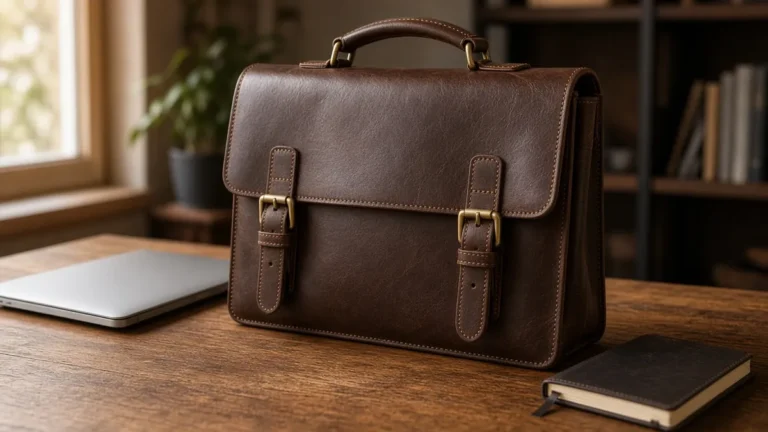
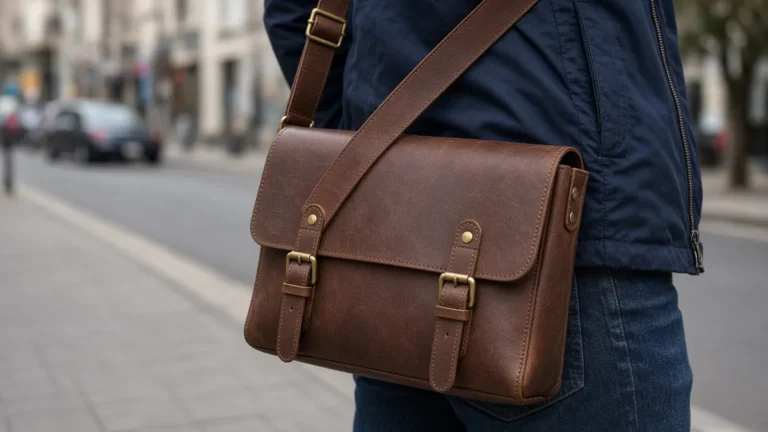
Structured flap with twin buckles over hidden magnetic catches, top handle (4 in drop) and a removable adjustable shoulder/crossbody strap. 12.5 × 9 × 3.25 in, 1.9 lb, back section for a 13-inch tablet or slim laptop. $205. Best for a smart work handbag; see the Rydal.
Kendal: the bucket bag
Oval base, leather drawstring through brass eyelets, magnetic tab, 11 in shoulder drop plus a removable crossbody strap. 9.75 × 9 × 4.75 in. $175 leather, $185 suede, $189 hair-on. See the Kendal.
Ripley: the saddle bag
Curved flap with a brass turn-lock, adjustable crossbody strap to a 22.75 in drop, 8.75 × 7.5 × 2.75 in. Phone, card wallet, keys, sunglasses. $165. See the Ripley.
Tilly: the mini top-handle
8.75 × 6.25 × 3.5 in, top handle plus detachable crossbody strap, zip top, stands on its own base. $145. See the Tilly.
Mabel: the clutch
11 × 7.5 × 0.75 in, foldover magnetic flap, fits up to an 11-inch tablet. $135 in leather, $145 in hair-on cowhide. See the Mabel.
Browse the full range of leather handbags, or read how our bags are made.
Browse more guides in the Leather Guide.
Bags mentioned in this guide
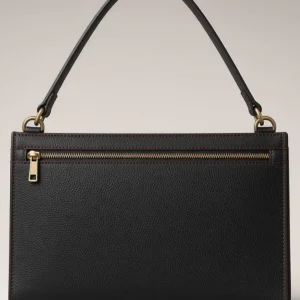 The Ashby — Black Leather Shoulder Bag$185.00View the bag
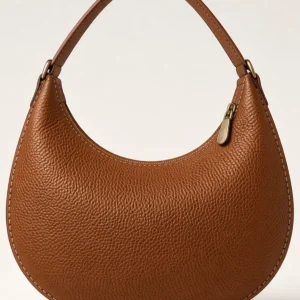 The Hollis — Cognac Leather Hobo Bag$185.00View the bag
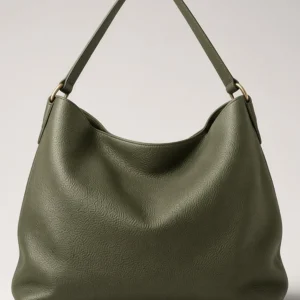 The Selby — Olive Slouchy Leather Shoulder Bag$175.00View the bag
 The Coniston — Chocolate Buffalo Leather Shoulder Purse$195.00View the bag
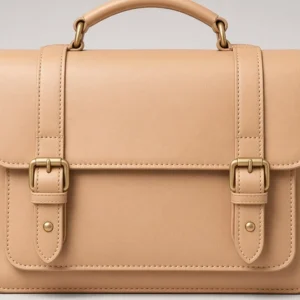 The Rydal — Tan Leather Satchel$205.00View the bag
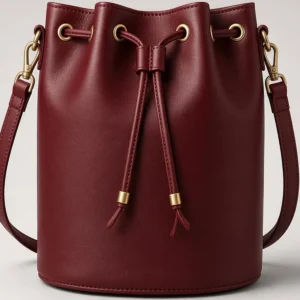 The Kendal — Oxblood Leather Bucket Bag$175.00View the bag
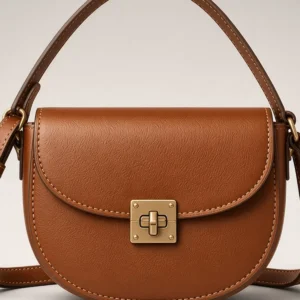 The Ripley — Cognac Leather Saddle Bag$165.00View the bag
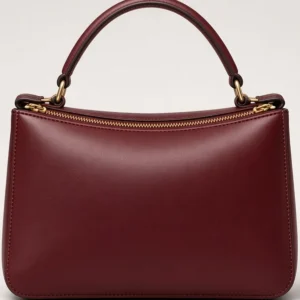 The Tilly — Oxblood Mini Leather Bag$145.00View the bag
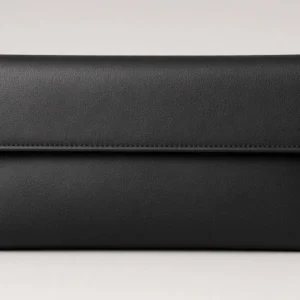 The Mabel — Black Leather Clutch Bag$135.00View the bag
Frequently asked questions
How can you tell if a leather handbag is good quality?
Check for full-grain leather with visible natural grain, small even stitching with reinforced handles, smooth burnished or folded edges, a stitched-in lining, solid metal hardware and full specifications on the listing.
What is the best quality leather for a handbag?
Full-grain leather is the best quality for durability and ageing, ideally aniline or semi-aniline finished so the grain shows through. Buffalo leather is tougher still; soft leathers like nappa are more delicate.
Is “genuine leather” good quality?
Not usually. “Genuine leather” is real leather, but the term is mostly used for lower-grade split leathers with a coated surface. Look for “full grain” instead.
Are expensive designer handbags better quality?
Often the materials and finishing are excellent, but much of the price pays for the brand and retail. A full-grain, well-finished bag from an independent maker can match the build quality for far less.
How long should a quality leather handbag last?
With reasonable care, a well-made full-grain leather handbag can last a decade or more, and stitching, edges and linings can be repaired along the way.
What handbag style is most versatile?
A medium structured shoulder bag or a crossbody in black or dark brown works for the widest range of days and outfits.
Does real leather peel?
Full-grain leather doesn’t peel. Peeling is a sign of a coated, bonded or PU material, where a plastic surface layer separates from its backing.
How do I care for a leather handbag?
Wipe it regularly, condition smooth leather a few times a year, brush suede, dry wet leather slowly away from heat, and store it stuffed in a dust bag rather than hanging by its strap.