Does Leather Stretch? How Much, Where, and How to Control It
Leather does stretch, but only a little, mostly in its first weeks of use, and in the direction it's pulled. Here's why it happens, which leathers give most, what will never stretch, and how to stretch, stop or fix it on bags, straps, shoes and jackets.
Yes, leather stretches, but only a little, mostly in its first weeks of use, and in the direction it’s pulled. Once it has stretched it doesn’t spring back. A new strap settles a little longer, a stiff tote relaxes and opens up, and tight shoes give a bit across the width. What leather won’t do is grow a size: shoes don’t get longer, jacket sleeves don’t lengthen and a strap that’s far too short won’t become the right length.
We cut and stitch leather bags for a living, and stretch is one of the things we plan around: which part of the hide each piece comes from, which way it’s cut, how straps are built and how much load a handle will take. So, does leather stretch enough to matter? This guide explains what’s actually happening inside the leather, how much stretch to expect on bags, straps, shoes and jackets, how to stretch leather safely when you want it, and how to stop it when you don’t.
Quick answer: Real leather stretches slightly and permanently under steady load, faster when it’s damp or warm. Soft, thin leathers (lambskin, nappa, suede) give most; thick, firm leathers (buffalo, vegetable-tanned, belt leather) give least. PU and bonded “leather” barely stretch at all, they crack instead. Buy leather goods that fit now, not ones you hope will stretch.
Why leather stretches
Leather is skin that has been tanned so it won’t rot. Under the surface it’s a dense, three-dimensional weave of collagen fibre bundles, tighter near the grain (the outer surface) and looser in the layers underneath. When you pull on it, two things happen:

- Elastic stretch. The fibre weave flexes and recovers when you let go, like a spring. This is why a strap feels slightly springy.
- Plastic stretch (permanent set). Under steady or repeated load, the fibre bundles slide and straighten in the direction of the pull and settle into their new position. Part of the stretch stays when the load is removed.
Laboratory work on bovine leathers published in the Journal of the American Leather Chemists Association describes exactly this balance: when pulled, leather stretches considerably and keeps part of that extension when released, and repeated loading “beds in” the fibre network so it stretches less each time (JALCA). In plain terms, most of the stretch happens early, then it slows down and mostly stops.
That’s also why the direction matters. Hides have a “line” (the direction the fibres mostly run, roughly along the backbone) and stretch more across it than along it. A good maker cuts straps and handles along the line so they stretch as little as possible.
What makes leather stretch more (or less)
| Factor | Stretches more | Stretches less |
|---|---|---|
| Thickness | Thin leather (garment, lining, lambskin) | Thick leather (belt, strap, buffalo) |
| Tannage | Soft chrome-tanned, heavily fatliquored (oiled) | Firm vegetable-tanned |
| Part of the hide | Belly and flanks (looser fibres) | Back and shoulder (tighter fibres) |
| Cut direction | Across the line of the hide | Along the line of the hide |
| Moisture and heat | Damp or warm leather | Dry, room-temperature leather |
| Construction | Single layer, unlined, unreinforced | Two layers stitched together, lined or reinforced |
| Age | New leather, first few weeks | Leather that has already “settled” |
How much does leather stretch?
There’s no single number, because it depends on the leather, the construction and the load. As practical guidance:
- Bag straps settle a little in the first weeks, usually enough to notice on an adjustable strap or a buckle hole that has started to oval, rarely more. A strap that keeps lengthening noticeably after that is a sign of thin, poorly cut or unreinforced leather.
- Tote and shoulder bag bodies relax rather than stretch: the opening widens slightly and the sides soften, especially on soft or slouchy leathers. A structured bag holds its shape longer.
- Shoes give a little across the width and over the toes as they mould to your feet, but they don’t get longer.
- Jackets relax a little across the shoulders and chest, not in sleeve or body length. Clothing retailers commonly describe this as up to about half a size across the body, and soft lambskin gives more than cowhide.
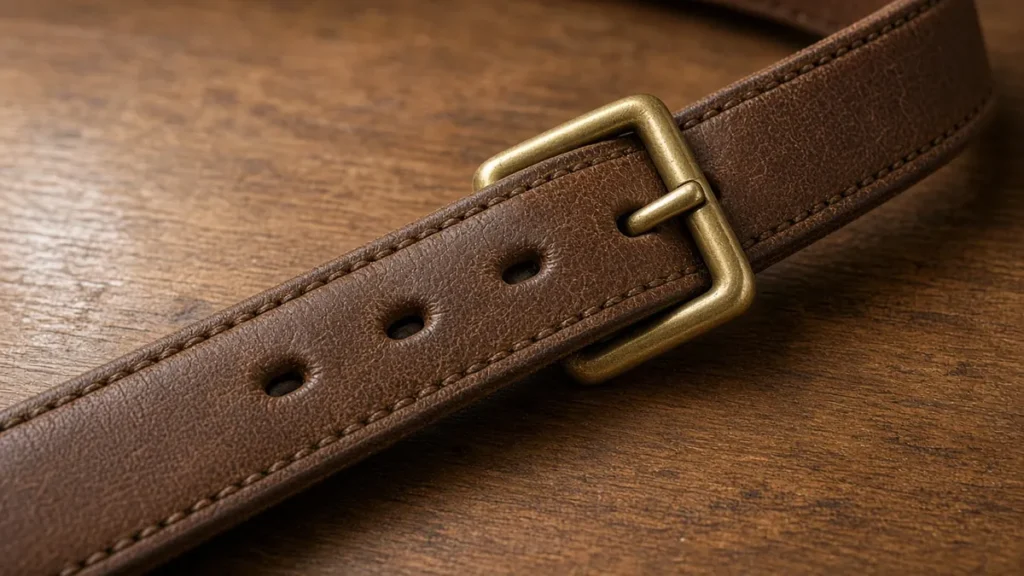
- Belts settle onto a slightly different hole after a month or two, because the leather between the buckle and the hole you use takes all the load.
- Gloves and watch straps mould to the hand or wrist quickly; that’s part of why they’re made from thin, soft leathers.
The useful rule: expect leather to settle, not to grow.
Which leathers stretch most?
| Material | How much it stretches | What to expect |
|---|---|---|
| Lambskin and other thin garment leathers | Most | Soft and comfortable fast; can bag at stress points |
| Nappa (soft, smooth leather) | More than average | Softens and slouches; see what nappa leather is |
| Suede | More than smooth leather of the same thickness | It’s the split side with no grain layer to hold it |
| Full-grain cowhide | Moderate | Settles early, then holds; ages and softens with use |
| Buffalo leather | Low | Thick and dense; very little stretch in straps |
| Vegetable-tanned leather | Low when dry, more when wet | Firm; can be shaped (and distorted) when damp |
| Hair-on hide | Low to moderate | Leather side behaves like the base hide |
| Top grain / corrected grain | Similar to the base hide | The finish can crack where it’s flexed hard |
| Bonded leather | Almost none | Breaks or delaminates instead of stretching |
| PU / faux leather | Almost none | The coating cracks and peels at folds; see PU vs real leather |
| Waxed canvas | Very little | Woven cotton; holds its size, creases instead |
The grain layer (the outer surface) is the strongest, tightest part of a hide, which is one more reason full grain holds up better than leathers that have had that surface sanded away or split off.
Where you’ll notice stretch on a leather bag
Leather bags take load in a few predictable places. That’s where stretch shows first, and where good construction makes the biggest difference.
- The shoulder strap. Carries the whole weight of the bag, often on one side. Look for straps cut in one piece along the hide, or two layers stitched back to back, and for an adjustable strap so a little settling doesn’t matter.
- Buckle holes. The leather around the hole you use most takes concentrated force, so the hole goes slightly oval. That’s normal and cosmetic on a thick strap.
- Handle roots. Where a handle meets the bag, stitching, rivets and a reinforced tab spread the load. Weak attachments pull and stretch the leather around the stitches first.
- The opening of an open-top tote. Heavy items pull the sides outwards over time, so the mouth relaxes. A magnetic tab or zip helps keep the shape.
- The base and gussets. Softer leathers sag if the bag is regularly overloaded or hung by one handle.
Stretch vs a fault
Normal stretch is small, happens early and then stops. Treat these as faults rather than “breaking in”:
- a strap that keeps lengthening month after month;
- stitches pulling through the leather at the handle roots;
- cracks or a peeling surface (that’s a coating failing, common on PU and bonded leather);
- a strap that tears at a hole.
If you’re seeing those on a bag from us, it’s a warranty question: we cover our stitching for life and our hardware for five years.
Does leather stretch when wet?
Yes, faster. Water lets the fibre bundles slide more easily, so damp leather under load stretches further and, importantly, sets in whatever shape it dries in. Saddlers and shoemakers use this on purpose when they wet-form leather. For everyone else it’s the main risk: a soaked bag hung by its strap, or a damp belt left buckled tight, can dry permanently longer or out of shape.
If your bag gets wet, empty it, blot it, stuff it loosely with plain paper so it dries in its proper shape, and let it dry flat or upright at room temperature, away from radiators and hair dryers. Our guide to what to do when leather gets wet walks through it step by step.
Does leather shrink?
It can, but not like wool in a hot wash. Two things cause it:
- Drying too fast or too hot. Heat drives the moisture and oils out of the fibre network, the fibres contract, and the leather turns stiff, smaller and prone to cracking. This is damage, not a fix.
- Relaxation after manufacturing. Hides are stretched flat during tanning and making. Over time, and sometimes after professional cleaning, some of that tension relaxes. The Drycleaning Institute of Australia describes this “relaxation shrinkage” in leather garments after cleaning, and notes that the snugness usually eases again as you wear the garment (Drycleaning Institute of Australia).
Shrinking leather on purpose with heat isn’t something we recommend for bags. It’s unpredictable and usually leaves the leather hard and dull.
How to stretch leather safely
Sometimes you want a little extra give: shoes that pinch, a belt that’s half a hole too tight, a stiff new strap. Work slowly and in small steps.
Shoes and boots
- Wear them in at home in thick socks for short spells. Body heat and movement do most of the work.
- Use a shoe stretcher (a two-way stretcher for width, or a bunion attachment for a pressure point), turning it a little at a time and leaving it in for a day or two.
- Use a leather stretch spray on the inside, or a 50:50 mix of rubbing alcohol and water, after a spot test on a hidden area, then wear or use the stretcher while damp.
- See a cobbler for anything more than half a size. Professional stretchers apply even pressure and won’t tear seams.
Leather shoes stretch in width, not length. If your toes hit the end, the shoe is too short.
Belts and straps
- Have an extra hole punched by a cobbler or with a proper rotary punch, rather than forcing the buckle.
- Don’t wet a strap to stretch it. It will stretch unevenly and can dry stiff.
- For a slightly stiff new bag strap, simply use it. Leather softens with flexing, and it’ll drape better within a couple of weeks.
Jackets and gloves
Wear them. A jacket relaxes across the shoulders and back with body heat and movement. Avoid soaking a jacket and wearing it dry, a common online tip that risks water marks and stiff, cracked leather. Gloves can be gently eased over the fingers with a glove stretcher.
Bags
Don’t try to stretch a bag. If a bag is too small, it’s the wrong bag; forcing in more than it was designed for strains handle roots and seams. Choose the right size instead (our size guide lists real dimensions and what fits).
How to stop your leather bag stretching
You can’t stop leather settling, but you can keep it small and even.

- Don’t overload it. Most stretch and handle damage comes from carrying far more weight than the bag was made for, every day.
- Use both handles on a tote, not one, and switch shoulders now and then.
- Don’t hang a bag by its strap in storage. Store it upright on a shelf, stuffed loosely with paper or a pillowcase so it keeps its shape.
- Dry it slowly if it gets wet, stuffed and away from heat, so it doesn’t set in a stretched shape.
- Don’t over-condition. Conditioner keeps leather supple, but soaking a strap in oil softens it and makes it stretch more. Twice a year is plenty for most bags (see how to clean a leather bag and how to care for leather bags).
- Use an adjustable strap, and move to the next hole when the strap settles rather than letting the bag hang lower than you like.
- Choose dense leather for heavy loads. If you carry a laptop every day, firm full-grain or buffalo leather straps stretch far less than soft, thin ones.
How to fix leather that has stretched
| Problem | Fix |
|---|---|
| Strap a little too long | Use the next hole; have a new hole punched |
| Buckle hole gone oval | Normal; move to a new hole if it’s unsightly |
| Strap much too long or thin and twisting | A leather repairer can shorten it or make a new strap |
| Tote opening relaxed | Store it stuffed; carry heavy items in a pouch inside |
| Handle drop has lengthened | A repairer can re-set or replace the handles |
| Shoes now too loose | Insoles or tongue pads; leather won’t shrink back reliably |
| Jacket loose across the body | A tailor experienced with leather can take it in at the seams |
What you can’t do reliably is “shrink it back”. Heat and water tricks tend to stiffen leather and leave marks, and they don’t restore the original fibre structure.
Buying advice: what never stretches
- Length. Shoes, sleeves, strap length beyond a small settling, belt length overall.
- Seams and closures. A zip that won’t close won’t start closing; a seam that pinches won’t move.
- Coated and synthetic materials. PU, bonded and heavily coated leathers don’t mould to you; they crack.
So buy leather that fits, or very nearly fits, today. For bags, that means checking the strap drop and the inside dimensions against what you carry, not hoping the leather will make room.
Does faux leather stretch?
Barely. PU and PVC “leathers” are a plastic layer on a fabric backing. The fabric may give slightly, but the coating can’t stretch with it, so instead of moulding to you it creases, cracks and eventually peels, usually at the strap folds and handle roots. That’s one of the clearest practical differences between faux and real leather, and the reason a faux-leather strap that feels comfortable on day one rarely improves.
Browse more guides in the Leather Guide.
Frequently asked questions
Does real leather stretch over time?
Yes, slightly and permanently, mostly in the first weeks of use and in the direction it’s pulled. After that initial settling it stretches very little. It won’t get noticeably longer or bigger.
How much does leather stretch?
It depends on the leather and the load. Expect a little settling on straps and belts, a softer, slightly wider opening on totes, some give across the width of shoes and about up to half a size across the body of a jacket, not in length.
Do leather bag straps stretch?
A little. A new strap usually settles slightly longer and the buckle hole you use may go oval. A well-cut, reinforced strap stops stretching after that; one that keeps lengthening is a sign of thin or poorly cut leather.
Does leather stretch when wet?
Yes. Damp leather stretches more easily and sets in the shape it dries in. Don’t hang a wet bag by its strap or wear wet leather tight. Stuff it and dry it slowly at room temperature, away from heat.
Does leather shrink?
It can shrink and stiffen if it’s dried too fast or with heat, and leather garments can relax and shrink slightly after cleaning. Shrinking leather on purpose isn’t reliable and usually damages it.
Will tight leather shoes stretch?
They’ll give a little across the width and over the toes, and you can help with a shoe stretcher or a cobbler. They won’t get longer, so shoes that are too short won’t become comfortable.
Does faux leather stretch?
Hardly at all. PU and PVC faux leathers crease and crack instead of stretching, which is why they don’t mould to you the way real leather does.
Does suede stretch more than leather?
Usually, yes. Suede is the inner side of the hide without the tight grain layer, so it gives more than smooth leather of the same thickness.
Can you un-stretch leather?
Not reliably. You can shorten a strap, punch a new hole or have a repairer take in a seam, but heat and water tricks to shrink leather back tend to stiffen and mark it.