Best Leather Backpacks for Men: Styles, Fit and What to Look For
A cool leather backpack looks good because it's simple, well proportioned and built from leather that ages well, and it's only worth owning if it also carries comfortably. This guide covers backpack styles, leathers, weight, laptop fit, straps and closures, then gives an honest look at what we make.
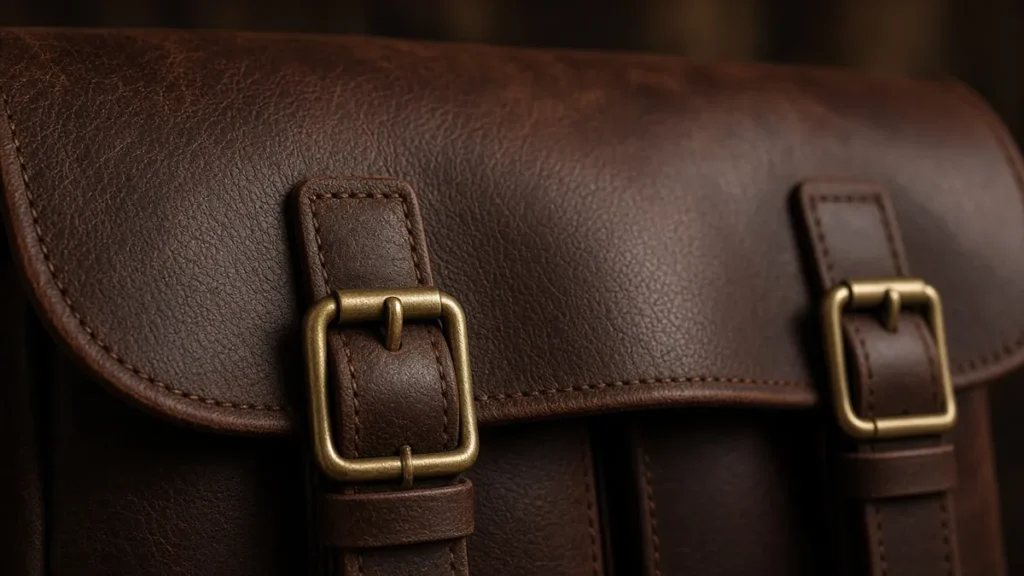
A cool leather backpack looks good because it’s simple: clean lines, well-chosen leather that ages with character, and hardware that’s there for a reason. It’s only worth owning, though, if it also carries comfortably. Leather is heavy, and a backpack is the one bag where every extra pound sits on your shoulders all day. The best ones balance both.
This guide to cool leather backpacks for men covers the styles that make a leather backpack look sharp, which leathers age best, how much weight to expect, how to check laptop fit and strap comfort, and the questions to ask before you buy.
Honest note: We make leather bags, but we don’t make an all-leather backpack. Our only backpack is the Kirkby, a waxed canvas backpack with full-grain leather trim, base and straps. We explain below when that hybrid is the better choice and when you should buy a full-leather backpack from someone else. We haven’t tested other brands’ backpacks, so we don’t rank them; use the criteria in this guide to judge any backpack, including ours. Prices are as listed in October 2026.
What makes cool leather backpacks for men look the part
Style is personal, but the leather backpacks that look best on most men share a few things:
- A simple silhouette. One main body, a flap or a clean zip, few external pockets. Lots of straps, tabs and logos look busy in leather.
- Leather that shows its character. Full-grain or pull-up leathers that darken and pick up highlights where they flex. Uniform, plasticky surfaces look cheap fast.
- Proportion. A pack roughly as wide as your torso and no taller than your back. Oversized leather backpacks look like luggage.
- Purposeful hardware. Solid brass or steel buckles, solid zips. Shiny plated fittings date quickly.
- Matched colours. Dark brown, black, tan and olive with brass work with almost anything; cognac and tan look more vintage and casual.
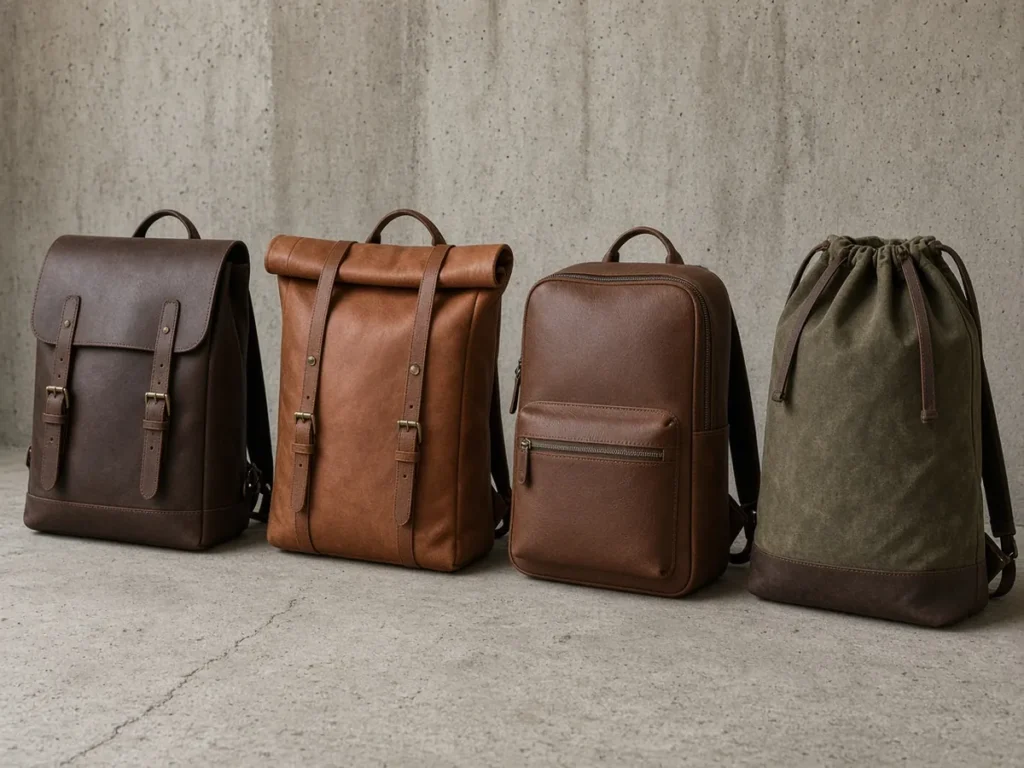
Leather backpack styles
| Style | Look | Pros | Cons | Best for |
|---|---|---|---|---|
| Flap rucksack (buckled) | Heritage, outdoorsy | Very stylish; flap sheds rain | Buckles are slow; check for hidden magnets or clips | Weekends, smart-casual offices |
| Zip daypack | Modern, minimal | Fast access; secure | Can look plain; zip quality matters | Commuting, travel |
| Roll-top | Utilitarian, urban | Expands; weather-resistant | Leather roll-tops can be stiff | Bike commuting |
| Drawstring with flap | Relaxed, vintage | Large capacity | Contents shift | Weekend trips |
| Convertible briefcase-backpack | Business | Handles for meetings, straps for travel | Often heavy; straps tuck away awkwardly | Office with long commutes |
| Mini backpack | Fashion-forward | Light | Not much fits | Evenings, city days |
| Canvas and leather hybrid | Heritage, rugged | Lighter, water-resistant | Not all-leather | Everyday carry, cycling, campus |
Which leather?
| Leather | Character | Weight | Care |
|---|---|---|---|
| Full-grain cowhide | Ages into a rich patina | Medium to heavy | Condition 2–3 times a year |
| Pull-up / oiled (“crazy horse”) | Rugged; lightens where flexed, scratches buff out | Medium to heavy | Very forgiving |
| Buffalo | Thick, bold grain, very tough | Heavy | Forgiving; condition yearly |
| Vegetable-tanned | Firm, darkens strongly with sun and use | Heavy | Avoid soaking; marks easily at first |
| Suede | Soft, casual | Lighter | Brush; avoid rain |
| Top grain / corrected | Uniform, smooth | Medium | Can crack where it flexes |
| PU or bonded | Looks new briefly | Light | Peels at straps and corners |
| Waxed canvas + leather trim | Heritage, softens and creases | Lightest | Re-wax canvas yearly |
If longevity is the goal, full grain is the leather to look for. If a listing says “genuine leather” without saying which grade, ask; and see our guide to PU vs real leather for how to spot a synthetic.
Weight: the leather backpack’s real trade-off
An all-leather backpack is heavy before you put anything in it. Thick leather, a full-size body, a laptop compartment and metal hardware add up: many full-size leather backpacks weigh 3 lb or more empty, and some pass 5 lb. Add a 3–4 lb laptop, a charger, a water bottle and a jacket, and you’re carrying 10 lb or more.
A common rule of thumb is to keep a loaded backpack to roughly a tenth of your body weight for everyday carry. Whether or not you follow it exactly, the lesson holds: check the empty weight before you buy. If a brand doesn’t list it, ask.
Ways to keep weight down without losing the leather look:
- choose a slightly smaller body (a 15-inch laptop pack rather than a 17-inch one);
- choose a canvas-and-leather hybrid, with leather where it wears;
- avoid unnecessary external hardware;
- carry a lighter laptop sleeve inside rather than buying a heavily padded bag.
Our Kirkby weighs 2.2 lb empty, with a padded 15-inch sleeve. That’s the main reason we make it in waxed canvas with leather trim rather than all leather.
Size and capacity
Leather backpacks are rarely sold in litres, so judge by dimensions.
| Size | Typical dimensions (W × H × D) | Roughly | Fits |
|---|---|---|---|
| Mini | 9–10 × 11–12 × 4 in | 7–10 L | Tablet, wallet, small layer |
| Everyday | 11–12 × 15–16 × 5 in | 14–18 L | 13–15-inch laptop, notebook, lunch, jacket |
| Large | 12–13 × 17–18 × 6 in | 20–25 L | 15–16-inch laptop plus gym kit |
| Travel | 13–14 × 18–20 × 7–8 in | 25–35 L | Overnight clothes; check airline personal-item limits |
The Kirkby is 12 × 16 × 5 in, right in the everyday band.
Laptop fit
Measure your laptop’s body and compare it with the internal sleeve, not the outer dimensions of the bag. As a rough guide, a 13-inch laptop is about 12 × 8.5 in and a 16-inch about 14 × 9.8 in (check your model; Apple lists sizes on its MacBook Pro specs page). A good laptop backpack has:
- a padded sleeve that holds the laptop off the bottom, so it doesn’t hit the ground when you put the bag down;
- a sleeve against your back, where the laptop is most protected and the weight sits closest to you;
- an opening wide enough that the laptop doesn’t scrape the zip or buckle.
Straps and comfort
The straps decide whether you’ll actually use a leather backpack.
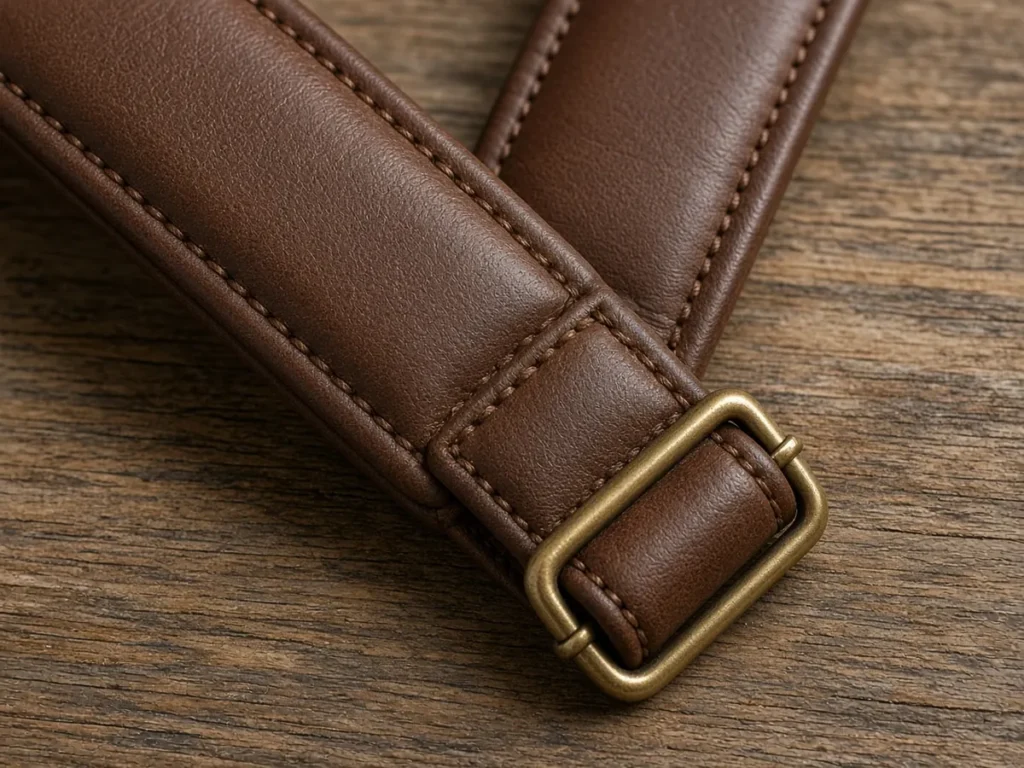
- Padded shoulder straps. All-leather straps without padding dig in under weight. Look for padding or wide, contoured straps.
- Adjustment at the base. Buckle or slider adjustment lets you lift the pack so it sits high on your back.
- Strap attachment. Straps should be stitched and riveted into the body, with a reinforced patch. This is a top failure point on cheap leather backpacks.
- A top grab handle. You’ll lift the bag by it more often than you think.
- A chest strap helps on long walks or a bike, though few leather backpacks have one.
- The back panel. A flat, slightly padded back keeps laptop corners out of your spine.
Closures and access
| Closure | Speed | Security | Weather |
|---|---|---|---|
| Buckled flap | Slow (unless buckles hide clips or magnets) | Medium | Good; flap sheds rain |
| Zip top | Fast | High | Medium; zips can leak |
| Roll-top | Slow | Medium | Very good |
| Drawstring + flap | Medium | Low to medium | Good |
If you’re in and out of your bag all day, a flap with decorative buckles over hidden quick-release clips or magnets, or a zip, will save frustration.
Pockets and organisation
Look for: a padded laptop sleeve, one zip pocket for keys and wallet, a couple of open pockets for a phone and chargers, and a pen loop. External zip pockets on the front are useful but break the clean leather look; a hidden back pocket against your body is the best spot for a passport or wallet on travel days.
Fit: getting a backpack to sit right
A backpack that’s the right size for your back is more comfortable than a lighter one that isn’t.
- Check the height against your back. The top of the pack should sit roughly level with the top of your shoulders, and the base should sit above your belt, not on your backside. Most everyday packs around 16 inches tall suit average to tall frames; shorter men may prefer 14–15 inches.
- Adjust both straps so the pack sits high and close. A low-hanging pack pulls you backwards and puts more load on your shoulders.
- Keep the weight close to your back. The laptop goes in the sleeve nearest you; heavy items next to it.
- Use both straps. It looks neater and it spreads the load.
- Check the strap length over a coat. Straps that only just fit over a T-shirt won’t fit over a winter coat.
Features ranked by usefulness
Not every feature is worth its weight in leather. In rough order of how much difference they make:
- A padded laptop sleeve, raised off the base.
- Padded, adjustable shoulder straps with strong anchors.
- A quick-opening closure (zip, or buckles over hidden clips or magnets).
- A zip pocket for keys and wallet.
- A top grab handle.
- A hidden back pocket for a passport or phone.
- A luggage pass-through for travel.
- A water-bottle pocket (rare on leather packs).
- A chest strap.
- External front pockets: useful, but they change the clean look.
Weather and leather backpacks
Leather is water-resistant, not waterproof. A flap closure sheds rain better than a zip, because water runs off the flap rather than into the zip line. Waxed canvas is the most weather-proof material here: rain beads and runs off, and a shower won’t soak through. After a downpour, empty the pack, stuff it with paper and let it dry slowly at room temperature, away from radiators. Condition leather once it’s dry. If you commute in rain most days, a canvas-and-leather pack is the practical choice; our guide to leather and water explains more.
Leather backpacks for travel
A backpack is an excellent personal item on a plane, because it fits under the seat and leaves your hands free in airports. Check your airline’s personal-item limit: American Airlines allows 18 × 14 × 8 inches (American), while United’s is 17 × 10 × 9 inches (United). Our Kirkby (12 × 16 × 5 in) is within American’s limit but wider than United’s 10 inches, so on United it would go in the overhead bin as your carry-on rather than under the seat. Useful travel features are a luggage pass-through, a hidden back pocket and a zip that can be locked.
Construction details to check up close
Photos and product pages tell you more than you’d expect, if you know where to look.
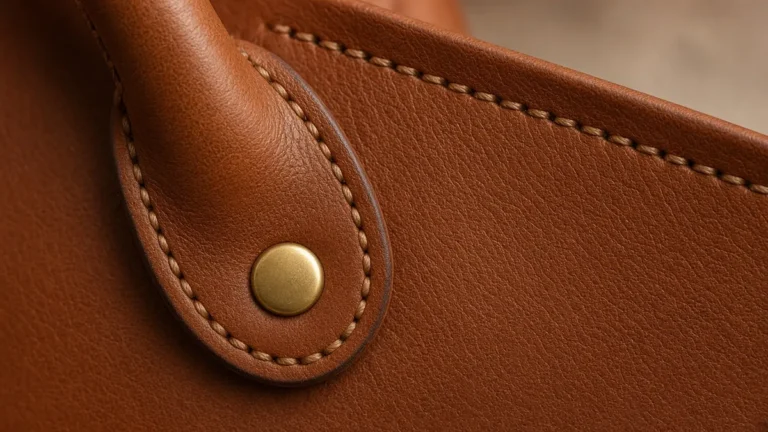
- Stitching. Small, even stitches in a thick thread, in straight lines. Around strap anchors and the grab handle you want extra rows, a box-and-cross stitch or rivets. Loose, wandering stitches mean the bag was sewn quickly.
- Edges. Burnished edges (sanded, dyed and polished) or folded edges last. Thick, rubbery edge paint can peel away in strips after a year or two.
- The base. A separate base panel, ideally in thicker leather, takes the wear when you put the bag down. On a hybrid pack, the base should be leather, not canvas.
- The lining. Stitched in, not glued. A glued lining is fine until it isn’t, and then it can’t be repaired.
- Zips. Heavy metal zips with leather pulls run more smoothly and last longer than light coil zips. Check that the zip ends are covered so they don’t scratch.
- Strap anchors. Look at where the shoulder straps meet the body at the top and bottom. A reinforced leather patch, stitched and riveted, is what you want.
- Hardware. Solid brass or stainless steel doesn’t flake. Plated zinc can turn grey and pitted.
What you get at each price
| Price (all-leather, full size) | What’s typical |
|---|---|
| Under about $150 | Often PU, bonded or thin split leather; glued linings; plated hardware |
| About $150–350 | Real leather, often full grain; quality varies most here, so check the details above |
| About $350–700 | Thicker full-grain leathers, better hardware, more hand finishing |
| $700+ | Designer labels; you’re often paying for the name as much as the leather |
Price alone doesn’t prove quality, but a full-size “full-grain leather” backpack at a very low price deserves a close look at the material description. Canvas-and-leather hybrids sit lower than all-leather packs of similar build quality, because canvas costs less and takes less work.
How a leather backpack ages
- First month. The leather is at its stiffest. Straps soften and settle slightly longer (see does leather stretch?), and the bag starts to shape itself to what you carry.
- First year. Full-grain and pull-up leathers darken, especially on the straps and where your hands go. Scuffs blend in. Waxed canvas develops creases and darker hand marks.
- Five years and beyond. A good leather backpack has a deep patina and a shape of its own. This is the point where a cheap one has usually cracked at the straps or peeled at the corners.
How to wear a leather backpack
- With a suit: a slim, dark, structured backpack in black or dark brown, with minimal hardware. Wear it high and carry it by the top handle into meetings.
- Smart casual: almost any leather or canvas-and-leather pack works with chinos, knitwear and a jacket. Brown, olive and tan with brass are the easiest.
- Casual: pull-up, buffalo and canvas packs look best with denim, workwear and outdoor jackets, and look better the more worn they get.
- Match your leathers loosely: a brown backpack with brown shoes and belt is classic; it doesn’t need to be an exact shade match.
- Wear both straps. It looks neater and it’s better for your back than slinging it on one shoulder.
Questions to ask before you buy
- What exactly is the leather: full grain, top grain or split, and what finish?
- What does it weigh empty?
- What are the internal dimensions of the laptop sleeve, and is it padded and raised off the base?
- How are the shoulder straps attached?
- Is the lining stitched in? Can it be repaired?
- What’s the hardware made of?
- What’s the warranty and return policy? (Ours: stitching covered for life, hardware for five years, 30-day returns; see our warranty.)
Which leather backpack for which use
Office and commuting
A clean zip daypack or a buckled flap with quick-release closures, in black or dark brown, with a padded sleeve. If your office leans formal, a leather briefcase or a leather messenger bag may look sharper with a suit; a backpack is the comfortable choice for long walks or a bike.
Cycling
Roll-top or flap packs shed rain. Waxed canvas with leather trim is lighter than all-leather and handles weather well. A chest strap helps.
Travel
A zip backpack with a hidden back pocket and a luggage pass-through. Check your airline’s personal-item size; it’s usually smaller than you’d think. Our best leather duffle bags guide covers carry-on sizes in detail.
Campus
A canvas-and-leather pack keeps the weight down when you’re also carrying books. Darker colours handle being dropped on floors.
Weekend and outdoors
A flap rucksack in pull-up or buffalo leather, or waxed canvas. Scratches and scuffs become part of the bag’s character.
Leather backpack vs messenger, sling and briefcase
| Bag | Best when | Downside |
|---|---|---|
| Backpack | Long walks, cycling, heavy loads | Have to take it off to get things out |
| Messenger | Quick access, smart-casual offices | One shoulder takes the weight |
| Briefcase | Formal offices, meetings | Hand or shoulder carry only |
| Sling or crossbody | Light days, travel days | Not for a laptop |
Care for a leather backpack
- Empty it and wipe it every couple of weeks with a soft, dry cloth.
- Condition the leather two or three times a year; the straps and the base need it most. Our leather cleaning guide explains how.
- Dry it slowly if it gets soaked, stuffed with paper, away from radiators (can leather get wet?).
- Re-wax canvas once a year on a hybrid pack, when it starts to absorb water.
- Store it stuffed and upright, not hanging by one strap.
Red flags when buying
- No empty weight listed, or a weight that seems implausibly light for an all-leather bag (it may be PU or thin split leather).
- Straps attached with a single line of stitching and no rivet or reinforcement patch.
- A laptop claim that doesn’t say whether there’s a padded sleeve.
- “Genuine leather”, “PU”, “vegan leather” or no material grade.
- Plated hardware that already looks grey at the edges in close-ups.
Leather backpack myths
“Thicker leather is always better.” Thicker leather is stronger, but on a backpack it’s also heavier and stiffer. A medium-weight full-grain leather, with thicker leather only on the straps and base, is usually the better design.
“A heavy bag means quality.” Weight can mean thick leather, or it can mean heavy cheap hardware. Check what the bag is made of, not just how much it weighs.
“Real leather backpacks don’t need padding.” Unpadded leather straps dig in under a laptop’s weight, however good the leather.
“Leather backpacks aren’t professional.” A slim, dark, structured backpack looks at home in most offices. It’s oversized, distressed or heavily strapped designs that look casual.
“Vintage-look means old-school quality.” Many “vintage” backpacks are distressed corrected-grain or PU, finished to look aged. Check the material line.
Who shouldn’t buy an all-leather backpack
Be honest with yourself about how you’ll use it. An all-leather backpack isn’t the best choice if you:
- walk or cycle long distances every day and want the lightest possible carry;
- commute in heavy rain most days;
- carry a 16-inch or larger laptop plus gym kit (the combined weight gets high);
- need lots of external pockets and quick access.
In those cases, a canvas-and-leather pack, a technical backpack, or a messenger for shorter commutes may suit you better.
Choosing a Kirkby colour
- Charcoal and black: the quietest, most office-friendly combination; hides marks best.
- Navy and chocolate: smart and slightly warmer; good with grey and navy clothes.
- Olive and tan: the classic heritage look; works with denim and outdoor jackets.
- Sand and cognac: lighter and more casual; shows wear more, which some people like.
- Stone and tan: the palest; best for spring and summer, and for people who want the canvas to show its history.
What we make: the Kirkby backpack
The Kirkby is a flap backpack in 18 oz waxed cotton canvas, with a full-grain leather base, trim and grab handle, two leather straps with solid brass buckles on the flap, and padded shoulder straps that adjust at the base.
| Spec | Kirkby |
|---|---|
| Size | 12 × 16 × 5 in |
| Empty weight | 2.2 lb |
| Laptop | Up to 15 inches, in a padded sleeve |
| Inside | Zip pocket and two open pockets |
| Closure | Flap with two leather straps and brass buckles |
| Price | $195 |
| Colours | Charcoal/black, olive/tan, sand/cognac, navy/chocolate, stone/tan |
Choose it if you want the look of a heritage leather rucksack with the weight and weather-resistance of canvas, especially for cycling, walking commutes or a first job. Don’t choose it if you want an all-leather backpack; it isn’t one. The charcoal and black is the quietest for an office.
If you’d rather carry all-leather and don’t need two shoulder straps, our closest alternatives are the Thirsk men’s crossbody ($195, 10.75 × 11.75 × 2.25 in, takes an 11-inch tablet), the Hexham large sling ($175, takes a mini tablet), and the Leyburn buffalo messenger ($235, 15-inch laptop). Browse all our waxed canvas bags.
Browse more guides in the Leather Guide.
Bags mentioned in this guide
 The Kirkby — Olive & Tan Waxed Canvas Backpack$195.00View the bag
 The Kirkby — Charcoal & Black Waxed Canvas Backpack$195.00View the bag
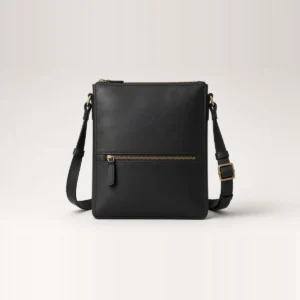 The Thirsk — Black Men's Leather Crossbody Bag$195.00View the bag
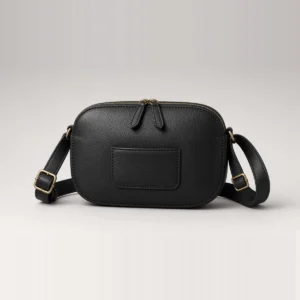 The Hexham — Black Large Leather Sling Bag$175.00View the bag
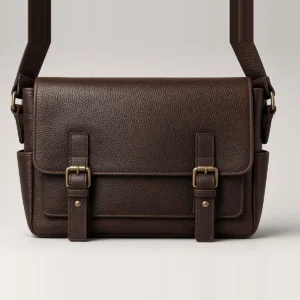 The Leyburn — Chocolate Buffalo Leather Messenger Bag$235.00View the bag
Frequently asked questions
Are leather backpacks good for everyday use?
Yes, if you choose a well-made one in a sensible size and check its empty weight. Full-grain leather stands up to daily use for years, but all-leather backpacks are heavy, so padded straps and a padded laptop sleeve matter.
How heavy is a leather backpack?
Many full-size all-leather backpacks weigh about 3 lb or more empty, and some exceed 5 lb. Canvas-and-leather hybrids are lighter; our Kirkby is 2.2 lb with a padded 15-inch sleeve.
What’s the best leather for a backpack?
Full-grain leather, especially pull-up or buffalo leather, ages best and hides scuffs. Avoid PU, bonded and unspecified “genuine leather”, which can crack and peel at the straps.
Will a 15-inch laptop fit in a leather backpack?
Many everyday leather backpacks around 12 inches wide and 16 inches tall fit a 15-inch laptop, but check the internal sleeve size against your laptop’s body, not its screen size.
Are leather backpacks waterproof?
No. Leather and waxed canvas are water-resistant: rain beads off for a while, but seams and zips let water in. Dry a soaked bag slowly away from heat.
Is a leather backpack professional?
A clean, dark leather backpack works in most offices. For formal dress codes, a briefcase or messenger bag looks more traditional.
How do I keep a leather backpack in shape?
Don’t overload it, store it upright and stuffed with paper, condition the straps and base a few times a year, and avoid hanging it by one strap.
Do you make an all-leather backpack?
Not at the moment. Our Kirkby backpack is waxed canvas with full-grain leather trim, base and buckled straps.