Small Bag Essentials: How to Carry Less Without Leaving Anything Important Behind
Moving from a big tote to a small bag is mostly about swaps, not sacrifice. This guide gives the six essentials, the swaps that free the most room, real sizes for everyday items, and how to choose a small bag that still fits your day.
Small bag essentials come down to six things: your phone, a slim cardholder with ID and one or two cards, the one key or fob you need today, one lip or touch-up product, one personal must-have (medication, glasses or an inhaler) and a few tissues or wipes. Everything else is a day-specific extra. The trick to carrying a small bag is not leaving things behind; it’s swapping bulky versions for slim ones. A cardholder instead of a wallet and a soft sunglasses sleeve instead of a hard case free up more space than anything else.
This guide is for anyone moving from a big bag to a small one, roughly 8 to 10 inches wide. It covers the essentials, the swaps that save the most room, real measurements for everyday items, what to add for different days, and how to choose a small bag that still fits your life. (For bags under 8 inches, see what fits in a mini bag.)
Disclosure: We are a leather bag workshop and the product boxes show our own bags, with prices as listed in November 2026. The packing advice applies to any bag.
The six small bag essentials
| Essential | Why | The small-bag version |
|---|---|---|
| Phone | Payments, tickets, maps, ID wallet | Your phone; skip a bulky folio case |
| Cards and ID | Backup when the phone fails | A cardholder with ID and 1 to 2 cards |
| Keys | Home and car | Only today’s key, or the fob alone |
| Lip or touch-up | The one item most people use daily | One multi-use product |
| Personal must-have | Medication, glasses, inhaler, contacts | A small pill case or soft glasses sleeve |
| Tissues or wipes | Spills, colds, sticky hands | A mini pack or a few folded tissues |
That’s it. If those six fit, the bag works. Everything below is about making them smaller and deciding what to add on a given day.
The swaps that free the most space
Downsizing fails when people try to fit their big-bag kit into a small bag. Swap the bulky versions first:
- Wallet → cardholder. A full wallet is usually the biggest single item in a bag. A cardholder with your ID and two cards is a fraction of the size; put loyalty and gift cards on your phone.
- Hard sunglasses case → soft sleeve. A hard case is about 6 by 2.5 by 2 inches and won’t bend. A microfiber sleeve folds to almost nothing.
- Keyring → today’s keys. Keep the full ring at home or in the car and carry one key or the fob. A loose fob is easier on your bag’s lining too.
- Makeup bag → one product. A tinted lip balm or a lip-and-cheek stick covers most touch-ups.
- Full-size bottles → minis. A 1 oz hand sanitizer instead of a 2 oz, and pills in a small case instead of the bottle.
- Charger and cable → slim power bank. If you need power, a thin magnetic battery fits flat against your phone; otherwise leave it.
- Receipts → nothing. Ask for email receipts, or clear the bag every evening.
These seven swaps usually shrink a typical load by half.
How big are everyday items, really?
Before you buy a small bag, compare these rough sizes with the bag’s inside measurements (inside is about half an inch smaller than outside in each direction).
| Item | Rough size | Fits a small bag (8 to 10 in wide)? |
|---|---|---|
| Standard phone (6.1 in screen) | 5.8 × 2.8 × 0.3 in | Yes |
| Large phone (6.7 to 6.9 in screen) | 6.4 × 3.1 × 0.3 in | Yes |
| Cardholder | 4 × 3 × 0.3 in | Yes |
| Bifold wallet | 4.5 × 3.5 × 0.75 in | Yes, but it fills the depth |
| Long zip wallet | 7.5 × 4 × 1 in | Only in 9 to 10 in bags |
| US passport | 5 × 3.5 × 0.2 in | Yes |
| Earbuds case | 2.4 × 1.8 × 0.9 in | Yes |
| Sunglasses, hard case | 6.3 × 2.6 × 1.8 in | Sometimes; needs depth |
| Sunglasses, soft sleeve | 6 × 3 × 0.75 in | Yes |
| Travel tissue pack | 4.3 × 2.2 × 0.9 in | Yes |
| 16.9 oz water bottle | 8.5 × 2.6 in round | No, except tall bags |
| E-reader | 6.2 × 4.3 × 0.3 in | In most 9 to 10 in bags |
The two measurements that matter most are inside width (your phone lies across it) and depth (a cardholder, keys and a lip balm stacked side by side need about 2.5 inches).
What to add, by day
Start with the six essentials, then add only what the day needs:
- Work day: your building pass, earbuds, a pen. If you need a laptop, carry a tote as well; a small bag can’t do that job.
- Errands: a folded reusable shopping bag, which takes about the space of a tissue pack.
- Travel day: your passport, a boarding pass on your phone, a slim power bank, and a zip-top bag that sits in front of you.
- Evening: less than you think: phone, one card, a key and a lip product.
- With kids: a few wipes and a small snack. Bigger supplies belong in a separate tote.
What doesn’t belong in a small bag
- A laptop or a full-size tablet
- A hardcover book (an e-reader or your phone app works instead)
- A full-size water bottle, unless the bag is tall enough to stand it in
- An umbrella you won’t need today: check the forecast
- Loose coins, receipts and expired coupons
How to choose a small bag that fits your life
Small bags fail in three predictable ways: too shallow, no pockets, or a strap that doesn’t suit how you carry. Check these before you buy:
- Width of at least 8.5 inches if you carry a large phone and want it to lie flat.
- Depth of at least 2.5 inches, so a cardholder, keys and a lip balm sit side by side without bulging.
- One inside pocket, so cards and keys don’t scratch your phone screen.
- A zip or a full flap, because small bags often travel crossbody in crowds.
- A strap that adjusts from shoulder to crossbody, so one bag covers more days. Our guide to shoulder bag vs crossbody bag explains strap drops.
- Structure if you carry little. A small bag with a firm body holds its shape half empty; a soft one can look limp.
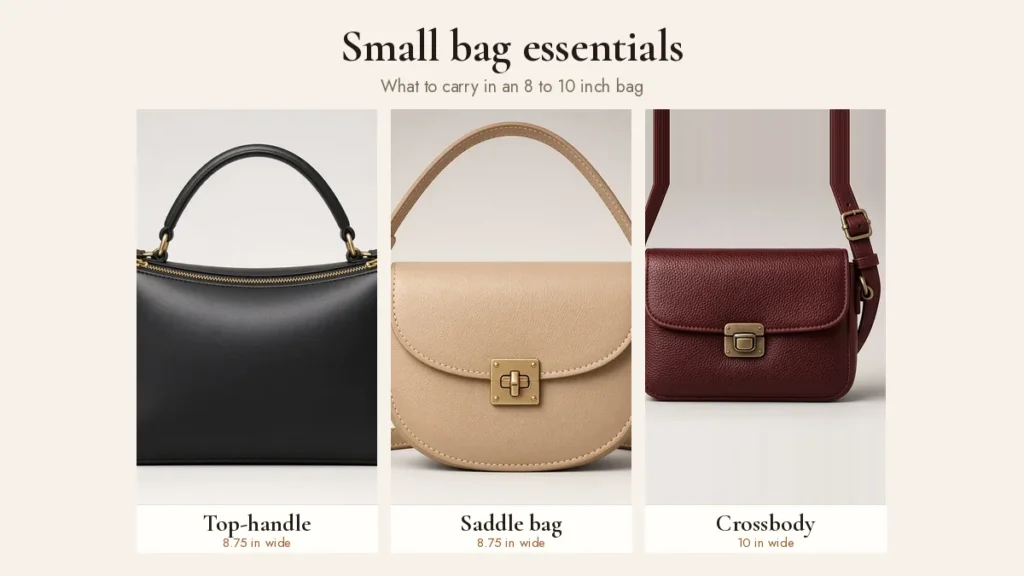
Here are three small bags measured the same way: a top-handle bag at 8.75 by 6.25 by 3.5 inches with a 4 inch handle drop and a crossbody strap; a saddle bag at 8.75 by 7.5 by 2.75 inches with a 22.75 inch strap drop; and a flap crossbody at 10 by 7 by 3 inches that takes a full wallet.
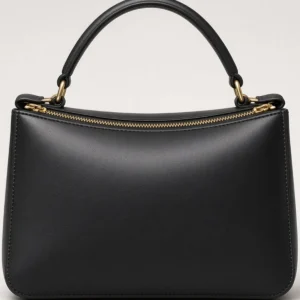
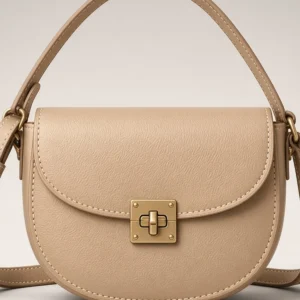
If you want one bag to do almost everything, the 10-inch flap crossbody is the safest step down from a big bag. It is the smallest size that still takes a bifold wallet and sunglasses in a soft sleeve.

How to keep a small bag organized
- Give everything a place. Phone in the main section against the back wall; cards and keys in the inside pocket; the lip product and tissues in front.
- Use one tiny pouch for loose bits like hair ties, bandages and a spare earring back.
- Empty it every night. Small bags fill up with receipts within days.
- Keep the key away from the leather. A keyring rubbing against the lining is the most common cause of wear inside small bags.
Small bag or mini bag?
A small bag (about 8 to 10 inches wide) carries the six essentials plus one or two extras. A mini bag (under 8 inches) carries the essentials and nothing more, and some won’t take a large phone lying flat. If you are wondering whether minis are worth it, read are mini bags still in style? and the measured guide to what fits in a mini bag.
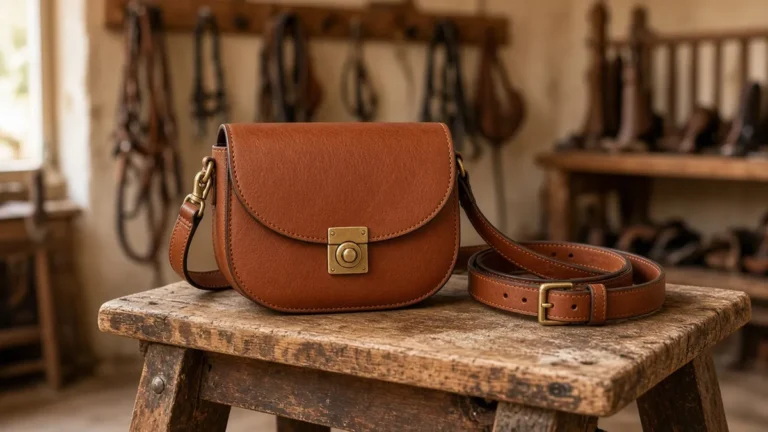
For scale, the mini below is 7.75 inches wide and 2 inches deep: a phone lying flat, a cardholder, a key and a lip product fit, but a glasses case and most extras don’t.

For the full list of what to carry in a regular-size bag, see what to keep in your everyday bag. Browse our mini leather bags and mini leather crossbody bags. Every bag is made to order and dispatched in 5 to 7 working days.
Frequently asked questions
What are the essentials for a small bag?
Your phone, a cardholder with ID and one or two cards, today’s key or fob, one lip or touch-up product, one personal must-have such as medication or glasses, and a few tissues. Add day-specific extras only when you need them.
How do I downsize from a big bag to a small one?
Swap bulky items for slim ones first: a cardholder instead of a wallet, a soft sunglasses sleeve instead of a hard case, one key instead of the full ring, and one multi-use beauty product instead of a makeup bag.
What size is a small bag?
Most small bags are about 8 to 10 inches wide, 6 to 8 inches tall and 2.5 to 3.5 inches deep. Bags under 8 inches wide are usually called mini bags.
Will a large phone fit in a small bag?
Yes, in most bags at least 8.5 inches wide. Large phones are about 6.4 inches tall, so they lie flat across the width of a small bag with room to spare.
Can a small bag fit a wallet?
A cardholder fits any small bag. A bifold wallet fits most bags with at least 2.5 inches of depth. A long zip wallet needs a bag about 9 to 10 inches wide.
What should I not carry in a small bag?
A laptop, a full-size tablet, a hardcover book, a large water bottle, an umbrella you won’t use and a pile of receipts.
Is a small bag enough for work?
For many people, yes, if a laptop lives at the office or travels in a separate tote. A small structured bag holds a pass, earbuds, a pen and the six essentials.